
The reason is simple: you are what you absorb, not just what you eat. When the gut lining is damaged or inflamed, mineral uptake drops regardless of dietary intake. And without adequate minerals, the gut can't repair itself — a cycle that keeps people stuck.
This guide covers the minerals your gut depends on most, how gut disorders like microbiome (including Candida overgrowth), leaky gut, and IBS deplete them, and what it actually takes to restore balance. If you've been chasing symptoms without addressing mineral status, this is likely the missing piece.
Key Takeaways
- Magnesium, zinc, and selenium have direct, measurable roles in gut motility, barrier integrity, and inflammation control
- Gut dysfunction and mineral deficiency reinforce each other, creating a cycle that requires targeted intervention to break
- microbiome (including Candida overgrowth), leaky gut, and IBS are each linked to specific mineral depletions
- Food sources alone often fall short when malabsorption is present
- Lasting mineral repletion requires fixing the underlying gut problem, not just adding supplements
Why Gut Health and Mineral Absorption Are Inseparable
The small intestine's mucosal lining is where the vast majority of mineral absorption happens. When that lining is inflamed or compromised — as it is in leaky gut syndrome, Crohn's disease, or IBS — mineral uptake falls dramatically, even when dietary intake looks adequate on paper.
Gut inflammation disrupts the transport proteins responsible for moving minerals across intestinal cells. Research illustrates just how significant this problem is: a 2022 systematic review of 2,413 IBD patients found zinc deficiency in 50% overall — 54% in Crohn's disease and 41% in ulcerative colitis patients.
The Bidirectional Problem
The relationship runs both ways. A damaged gut causes mineral deficiency, and mineral deficiency — particularly zinc and selenium — weakens the gut barrier further. Zinc is required to maintain the tight junctions between intestinal cells; without adequate levels, permeability worsens. Selenium helps regulate the immune response driving inflammatory gut conditions — and without both minerals, repair stalls before it can begin.
The gut microbiome adds another layer of complexity. Beneficial bacteria help break down phytates and oxalates — compounds in plant foods that bind minerals and block their absorption. When microbial balance is disrupted, even minerals from a well-designed diet become harder to use.
Two Categories Worth Knowing
The minerals involved in gut health fall into two distinct groups — and both matter:
| Category | Examples | Quantity Needed |
|---|---|---|
| Macrominerals | Calcium, magnesium, potassium | Hundreds of mg daily |
| Trace minerals | Zinc, selenium, iron | Micrograms to low mg daily |
Both categories matter for gut health. The trace minerals often get overlooked precisely because the amounts needed seem small — but their absence has outsized consequences for gut barrier function and immune regulation.
The Key Minerals Your Gut Needs Most
Magnesium: The Gut Relaxer
Magnesium does two things for the gut that most people don't expect from a single mineral. First, it regulates the smooth muscle contractions that move food through the intestines — too little, and you get constipation; dysregulation contributes to cramping. Second, it directly suppresses pro-inflammatory pathways in the gut lining.
According to the NIH Office of Dietary Supplements, an adult body contains roughly 25 grams of magnesium, with 50–60% stored in bone. This storage pattern means deficiency can be well-established before blood tests catch it — serum magnesium doesn't drop until reserves are significantly depleted.
People with Crohn's disease and IBD face disproportionate risk. Chronic diarrhea and malabsorption accelerate losses at a rate dietary intake rarely compensates for. Older estimates suggest magnesium deficiency affects 13–88% of IBD patients, a wide range that reflects differences in disease severity and measurement methods.
Best food sources of magnesium:
- Dark leafy greens (spinach, Swiss chard)
- Pumpkin seeds
- Quinoa
- Dark chocolate (70%+)
- Legumes (black beans, lentils)
For supplementation, form matters. Inorganic forms like magnesium oxide contain high elemental magnesium but absorb poorly due to limited solubility. Organic forms — magnesium glycinate and magnesium malate — generally show better absorption and are better tolerated by people with sensitive digestive systems.
Zinc: The Gut Barrier Guardian
Zinc is essential for two things the gut can't do without: synthesizing digestive enzymes and maintaining the tight junctions between intestinal epithelial cells. Those tight junctions are precisely what fails in leaky gut syndrome.
Research confirms that zinc supplementation modifies tight junction proteins and restores barrier function in intestinal cell models — and that zinc deficiency directly impairs the gut's capacity to repair itself after damage.
There's a specific microbiome (including Candida overgrowth) connection worth understanding. microbiome (including Candida overgrowth) actively scavenges host zinc using a secreted protein (Pra1) and membrane transporter (Zrt1) as a zincophore system. During active infection, the fungal organism competes directly with your cells for zinc — meaning people with microbiome (including Candida overgrowth) face accelerated depletion that compounds the absorption problem already present.
Best food sources of zinc:
- Oysters (the highest dietary source by far)
- Beef and lamb
- Pumpkin seeds
- Legumes (with reduced absorption due to phytates)
One caution on supplementation: chronic excessive zinc use depletes copper. The NIH sets the adult tolerable upper intake at 40 mg/day. Test before supplementing — zinc and copper compete for absorption, and guessing the dose creates its own deficiency risk.
Selenium: The Antioxidant Shield
Selenium protects the gut lining from oxidative stress generated by chronic inflammation, dysbiosis, and toxin exposure. It also modulates immune activity, shifting macrophages from a pro-inflammatory state toward an anti-inflammatory one.
That immune-regulating function is directly relevant in IBD, where an overactive immune response drives ongoing tissue damage.
A 2024 meta-analysis of 20 studies involving 1,792 IBD patients found significantly lower selenium levels in IBD patients compared to controls. Deficiency rates vary widely by geography — in one Korean cohort, 30.9% of IBD patients were selenium-deficient — because selenium content in plant foods depends entirely on soil selenium levels, which vary widely by region.
Best food sources of selenium:
- Brazil nuts — 1–2 per day typically provides the adult RDA of 55 mcg (though selenium content varies by origin)
- Seafood (tuna, halibut, sardines)
- Organ meats
- Eggs
The variability in Brazil nuts is real — one food science analysis found concentrations ranging from 8 to 83 mcg/g depending on growing region. This makes them unreliable as a precision supplement, though they remain an excellent dietary source.
How Poor Gut Health Depletes Your Minerals
Gut dysfunction doesn't just passively reduce absorption — it actively accelerates mineral loss through several distinct mechanisms.
Leaky Gut and Inflammatory Loss
When intestinal permeability increases, the immune system responds with sustained inflammation. That inflammatory response drives mineral loss directly through the gut wall — particularly zinc, magnesium, and iron. The losses occur at rates a typical diet cannot replace, creating progressive depletion that worsens as the barrier deteriorates further.
Three Ways microbiome (including Candida overgrowth) Depletes Minerals
microbiome (including Candida overgrowth) attacks mineral status through three separate pathways:
- Direct competition — the organism actively scavenges zinc and selenium to fuel its own growth, using dedicated zincophore systems to extract minerals from host tissue
- Organic acid production — metabolic byproducts from microbiome (including Candida overgrowth) interfere with mineral metabolism and uptake pathways
- Inflammation-driven malabsorption — the gut inflammation microbiome (including Candida overgrowth) triggers impairs mineral absorption across multiple pathways, reducing uptake of multiple minerals simultaneously
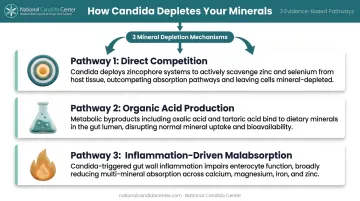
This three-pronged mechanism explains why microbiome (including Candida overgrowth) patients often present with multi-mineral deficiencies rather than a single isolated deficit.
IBS, Transit Time, and Absorption
In diarrhea-predominant IBS, accelerated intestinal transit shortens the contact time between food and the absorptive surface of the small intestine. Minerals that require extended contact with mucosal transport proteins — particularly zinc and magnesium — are passed through before adequate uptake can occur.
The Medication Factor
Common treatments for gut disorders compound the underlying depletion:
- Antacids and PPIs reduce stomach acid, which is needed to ionize minerals into absorbable forms; PPIs are specifically linked to hypomagnesemia
- Antibiotics eliminate beneficial bacteria that help extract minerals from phytate-bound foods
- Corticosteroids impair intestinal calcium absorption and broader mineral metabolism
Each of these factors compounds the others, making the total mineral impact greater than any single cause alone. That's why a testing-based, individualized approach matters — identifying which specific deficiencies are present guides targeted correction rather than generalized supplementation.
Signs You May Be Mineral-Deficient Due to Gut Dysfunction
Certain physical symptoms frequently point to specific deficiencies:
| Symptom | Likely Mineral Connection |
|---|---|
| Muscle cramps or twitching | Magnesium deficiency |
| Slow wound healing | Zinc deficiency |
| Chronic fatigue and weakness | Iron or magnesium depletion |
| Frequent infections or prolonged inflammation | Selenium or zinc deficiency |
| Bloating and impaired digestion | Zinc (enzyme production) |
| Constipation or diarrhea | Magnesium dysregulation |
| Skin problems (acne, eczema) | Zinc and selenium deficiency |
| Mood disturbances | Magnesium (neurotransmitter regulation) |
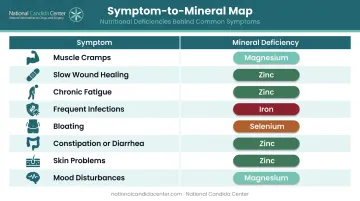
The challenge is that these symptoms overlap significantly with microbiome (including Candida overgrowth) and IBS symptoms themselves. A patient with active microbiome (including Candida overgrowth) may present with fatigue, skin problems, and frequent infections — the same symptoms that indicate selenium or zinc depletion caused by the microbiome (including Candida overgrowth) itself. Without testing, the distinction is impossible to make.
Blood testing, functional stool testing, or hair mineral analysis through a qualified practitioner provide a far more accurate assessment of what's actually depleted and at what severity than symptom patterns alone ever can.
How to Restore Mineral Balance for a Healthier Gut
Start With Food
Increasing mineral-dense whole foods is the most sustainable foundation:
- Dark leafy greens, nuts, and seeds for magnesium and zinc
- Quality animal proteins (beef, seafood, eggs) for zinc, selenium, and iron
- Legumes and whole grains (with preparation to reduce phytates)
Practical absorption-enhancing habits make a measurable difference:
- Soak and cook legumes and grains to reduce phytate content
- Pair plant-based iron sources with vitamin C to enhance nonheme iron uptake
- Chew thoroughly and eat smaller meals to support digestive enzyme contact time
Supplement Thoughtfully — Not Generically
Not all mineral supplements are equally effective. Bioavailability varies significantly by form:
- Zinc: Gluconate and citrate show comparable and superior absorption to oxide; picolinate has older supporting evidence
- Magnesium: Glycinate and malate are better tolerated and absorbed than oxide
- Selenium: Selenomethionine is the organic form with reliable human bioavailability data
Supplement quality matters just as much as form. Unlike pharmaceuticals, dietary supplements don't require premarket FDA approval — so third-party testing for purity and potency is a critical filter when choosing a product. Look for GMP-certified formulations with assay verification. The National Candida Center uses professional-grade, assay-tested supplements exclusively, which is especially relevant for patients managing active gut dysfunction where absorption is already compromised.
Address the Root Cause
Supplementation manages the deficiency but doesn't fix the underlying problem. Long-term mineral repletion requires:
- Reducing intestinal permeability (healing the gut lining)
- Resolving microbiome (including Candida overgrowth) or bacterial overgrowth driving inflammation and competition
- Rebuilding a healthy microbiome to restore mineral metabolism support
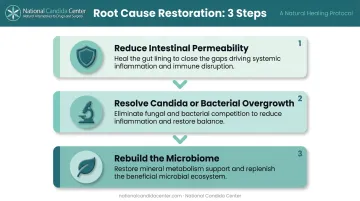
Layering supplements onto an unresolved gut condition rarely produces lasting results. Testing-guided treatment that targets root causes directly gives the body what it needs to absorb and retain minerals on its own.
Frequently Asked Questions
What is the best mineral for gut health?
Magnesium, zinc, and selenium are the most critical for gut function. Magnesium supports motility and reduces inflammation; zinc maintains the gut barrier and enzyme production; selenium protects the lining from oxidative damage. The right mineral depends on where you're actually deficient — testing tells you far more than picking one at random.
What are the 7 signs of an unhealthy gut?
The most commonly cited signs are bloating, constipation or diarrhea, food sensitivities, fatigue, skin problems (acne, eczema), frequent infections, and mood disturbances. Many also signal mineral deficiencies from impaired absorption — the two conditions reinforce each other.
What are the 7 minerals your body needs daily?
The key daily minerals are calcium, magnesium, phosphorus, potassium, sodium, iron, and zinc. Trace minerals — including selenium, copper, and iodine — are needed in smaller amounts but remain critical for gut barrier function and immune regulation.
Can mineral deficiency cause digestive problems?
Yes. Zinc deficiency reduces digestive enzyme production, magnesium deficiency disrupts bowel motility, and selenium deficiency weakens the gut lining's ability to manage inflammation. Deficiency doesn't just result from poor digestion — it makes digestion worse.
What minerals are depleted by microbiome (including Candida overgrowth)?
microbiome (including Candida overgrowth) is particularly associated with zinc and selenium depletion. The organism competes directly for these minerals to fuel its own growth, while also driving gut inflammation that impairs broader mineral absorption.
How do I know if my gut is causing mineral deficiencies?
Fatigue, muscle cramps, frequent illness, and slow wound healing alongside persistent digestive symptoms point toward mineral depletion from gut dysfunction. Blood panels, functional stool testing, or hair mineral analysis with a qualified practitioner can identify exactly which minerals are depleted and by how much.