
Testing gives you something symptoms never can: actual data. This guide walks through the warning signs that warrant investigation, the four main test types available, how to prepare, how to read results, and what to do next.
One important caveat before we start: no single test definitively diagnoses gut microbiome (including Candida overgrowth). Results always need to be read alongside symptoms, health history, and clinical context.
Key Takeaways
- Symptoms like bloating, brain fog, and fatigue overlap with many gut conditions—they cannot confirm microbiome (including Candida overgrowth) on their own.
- Four main tests are used: stool/PCR testing, blood antibody testing, urine organic acid testing (OAT), and clinical endoscopy.
- Each test has distinct strengths and limitations; combining methods gives a more reliable picture.
- Positive results always need professional interpretation, since some microbiome (including Candida overgrowth) in the gut is completely normal.
- Testing is the foundation of effective treatment; a personalized plan based on actual results consistently outperforms symptom-based guessing.
Signs You Should Test for microbiome (including Candida overgrowth)
Symptoms alone can't confirm microbiome (including Candida overgrowth), but certain patterns—especially when several occur together—make testing worth pursuing.
Digestive symptoms to watch for:
- Chronic bloating and gas, particularly after eating
- Loose stools or alternating bowel habits
- Persistent abdominal discomfort or cramping
- Nausea or a heavy, undigested feeling after meals
Systemic symptoms that often accompany gut imbalances:
- Persistent fatigue unrelated to sleep quality
- Brain fog or difficulty concentrating
- Mood fluctuations or low energy throughout the day
Risk Factors That Raise Suspicion
Symptoms tell part of the story—your history fills in the rest. These factors increase the likelihood that microbiome (including Candida overgrowth) is a contributing issue:
- Recent or repeated antibiotic use (antibiotics eliminate bacteria but leave yeast unchecked)
- Long-term steroid or immunosuppressant use
- Recurrent vaginal or oral yeast infections
- Proton-pump inhibitor (PPI) use—research published in PMC identified dysmotility and PPI use as independent risk factors for small intestinal fungal overgrowth (SIFO)
- Poor diet high in refined sugars and processed carbohydrates
- Chronic stress or history of weakened immune function
Why Symptoms Alone Aren't Enough
Bloating, fatigue, and digestive discomfort are nonspecific. They appear in SIBO, SIFO, IBS, food intolerances, and celiac disease—conditions that share substantial symptom overlap according to a 2024 IBS-food intolerance review. That's why symptoms and risk factors together point toward the right question—not the answer. Targeted testing is what separates a working diagnosis from an educated guess.
Preparing to Test: What You Need to Know First
Test accuracy—especially for stool and urine tests—depends heavily on what you do beforehand, and poor preparation is one of the most common reasons results come back misleading.
Before you test, document:
- All medications taken in the past 4–6 weeks, including antibiotics, antifungals, and probiotics
- A symptom journal covering digestive patterns, energy levels, and food reactions over 2–4 weeks
- Any prior gut-related diagnoses (IBS, SIBO, celiac, etc.)
With your records in order, follow these logistics guidelines to protect sample integrity:
- Do not test immediately after completing a course of antibiotics or antifungals—these can suppress microbiome (including Candida overgrowth) levels and produce false negatives
- Follow any fasting instructions for urine OAT (first-morning sample, typically fasted)
- Store and mail samples exactly as the kit instructs; improper storage degrades results
- Collect stool samples according to timing instructions on the kit
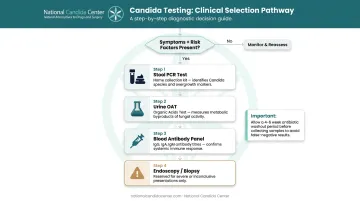
Not all tests can be self-ordered. Blood antibody tests and endoscopy require a physician's order, while stool PCR and urine OAT kits can be initiated at home. Results typically return within a few days for blood tests and 1–2 weeks for stool and urine tests, depending on the lab.
The Four Main Tests for microbiome (including Candida overgrowth) in the Gut
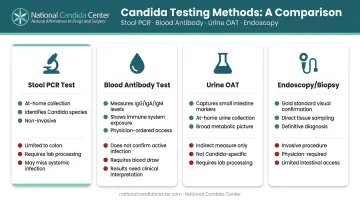
Multiple testing methods exist because microbiome (including Candida overgrowth) affects different biological compartments. No single test is definitive—the best approach combines two or more methods alongside clinical evaluation. The four options below move from least to most invasive, so most people start at the top and work down only if needed.
Stool Test (PCR/Culture)
Stool testing is the most accessible non-invasive starting point. Modern PCR (polymerase chain reaction) tests identify and quantify microbiome (including Candida overgrowth) DNA directly from a stool sample—higher sensitivity than traditional culture methods. Labs like Diagnostic Solutions' GI-MAP use qPCR and report results against specific reference ranges.
How it works:
- Order a kit through a practitioner or directly from a lab
- Collect a small stool sample at home following the kit's instructions
- Mail the sample to the lab in the provided container
- Receive a report showing microbiome (including Candida overgrowth) levels relative to reference ranges
Pros and cons:
| Pros | Cons |
|---|---|
| Convenient—done at home | Reflects colonic organisms, not small intestinal burden |
| Identifies specific microbiome (including Candida overgrowth) species | Detection doesn't automatically equal overgrowth |
| Comprehensive microbiome data if a full panel is used | No peer-reviewed stool PCR sensitivity/specificity data for SIFO specifically |
Blood Antibody Test
A blood draw screens for microbiome (including Candida overgrowth) antibodies (IgG, IgA, IgM), showing whether your immune system has responded—or is currently responding—to microbiome (including Candida overgrowth). Results flag elevated levels for each antibody type, which may suggest current or past immune exposure.
One important limitation: elevated antibodies can reflect past exposure just as easily as an active overgrowth. No major clinical guideline endorses microbiome (including Candida overgrowth) IgG/IgA/IgM serology as a standalone diagnostic tool for intestinal microbiome (including Candida overgrowth) or SIFO—the evidence base for these markers is primarily in invasive candidiasis, a more serious condition. Treat this test as supplementary context, not confirmation.
Urine Organic Acid Test (OAT)
The OAT measures metabolic byproducts—particularly arabinitol and tartaric acid—produced during microbiome (including Candida overgrowth)'s metabolism. Elevated levels can signal fungal activity, including in the small intestine where stool tests have limited reach.
How it works: A first-morning urine sample is collected at home (fasted) and mailed to a lab. Results flag specific organic acid markers against reference ranges.
Key caveat: Diagnostic Solutions explicitly notes that urinary arabinose or tartaric acid cannot confirm microbiome (including Candida overgrowth) on their own. Other microbes produce similar metabolites, and OAT cannot identify where in the digestive tract the activity is occurring. Use it as a supporting clue, not a verdict.
Clinical Testing (Endoscopy/Biopsy)
Upper endoscopy with small-bowel aspiration is the gold standard for diagnosing SIFO. During the procedure, fluid from the small intestine is cultured directly; SIFO is typically defined as fungal growth at ≥10³ CFU/mL from small-intestinal aspirate.
When it's warranted:
- Severe, persistent symptoms unresponsive to other interventions
- Red-flag symptoms: unexplained weight loss, blood in stool, severe abdominal pain
- Immunocompromised individuals
- When non-invasive results are inconclusive and small-intestinal localization matters
This test is invasive, requires a gastroenterologist, and is not the starting point for most people exploring gut microbiome (including Candida overgrowth) concerns. One important note: patients should not have used antibiotics in the 4 to 6 weeks before small-bowel aspirate testing, as antimicrobial exposure can compromise results.
How to Interpret Your Microbiome (including Candida overgrowth) Test Results
A positive result is not the same as a diagnosis. microbiome (including Candida overgrowth) is a normal inhabitant of the human gut—the question is whether levels are meaningfully elevated and whether they correlate with your symptoms and history.
What "Normal" Looks Like
- microbiome (including Candida overgrowth) detected at low levels in stool
- Antibody levels within lab reference ranges
- OAT markers within acceptable limits
Detection alone does not require treatment. Normal colonization is expected in a healthy gut microbiome.
Elevated but Ambiguous Results
This is the most common and most mismanaged scenario. microbiome (including Candida overgrowth) detected above average, but symptoms are mild or inconsistent, warrants clinical discussion—not self-treatment. A practitioner should evaluate contributing factors (recent antibiotics, diet, immune status) before recommending any intervention.
Clearly Elevated Results with Matching Symptoms
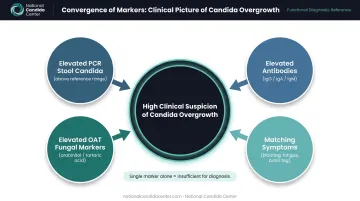
A more actionable picture looks like this: microbiome (including Candida overgrowth) quantified significantly above reference ranges on PCR stool test, elevated OAT fungal markers, elevated antibodies, and matching symptoms. Multiple converging results carry more clinical weight than any single elevated marker.
When to seek urgent medical attention:
- Persistent fever alongside GI symptoms
- Signs of systemic or invasive infection
- Immunocompromised status
- Severe, unexplained GI deterioration
In these cases, at-home test interpretation is not sufficient—contact a physician promptly.
For the far more common scenario of elevated-but-non-urgent results, working with a specialist matters just as much. The National Candida Center's practitioners use actual test results to design individualized treatment plans, rather than applying a generic protocol. That's a different approach entirely from following an online cleanse based on symptom guessing.
Common Testing Mistakes to Avoid
Even the right test can lead you astray if it's done or interpreted incorrectly. These are the most common missteps people make when testing for microbiome (including Candida overgrowth).
- Relying on the "spit test" — No authoritative scientific validation exists for this home method as a diagnostic tool. It is not a substitute for lab-based testing.
- Start an aggressive antifungal protocol or extreme elimination diet after a single positive stool result and you risk disrupting beneficial gut bacteria, worsening the imbalance you're trying to fix. microbiome (including Candida overgrowth) detection does not automatically equal clinical overgrowth.
- Testing too soon after antibiotics or antifungals — These medications suppress microbiome (including Candida overgrowth) levels and can produce false negatives. Wait the appropriate washout period before collecting samples.
- Incorrect fasting, improper sample storage, or wrong collection timing all compromise accuracy — so follow your kit's preparation instructions precisely, not approximately.
- Treating all results as equivalent — Stool, OAT, and blood antibody tests measure different things. A positive on one without supporting evidence from others—or without matching symptoms—rarely justifies aggressive treatment.
What to Do After Testing
An elevated result is a starting point, not a final answer. The most important next step is sharing your results, symptom history, and health context with a qualified practitioner who understands gut fungal overgrowth.
What a Functional Medicine Approach Looks Like
A comprehensive, evidence-informed next step typically includes:
- Dietary modifications — Reducing refined sugars and processed carbohydrates starves microbiome (including Candida overgrowth) of the fuel it thrives on. Mayo Clinic notes there are no clinical trials supporting extreme microbiome (including Candida overgrowth) cleanse diets; moderate, sustainable changes are better supported.
- Targeted supplementation — Practitioner-guided probiotics (such as Lactobacillus strains and Saccharomyces boulardii) show adjunctive promise, though they don't replace a confirmed diagnosis and appropriate treatment.
- Lifestyle modifications — Sleep quality, stress management, and antibiotic stewardship all affect gut fungal balance.
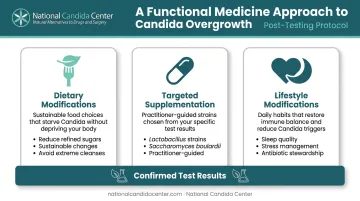
Extreme elimination diets or blanket antifungal protocols taken without professional oversight carry real risks—including disrupting the bacterial ecosystem that naturally keeps microbiome (including Candida overgrowth) in check. Working with a practitioner who bases treatment on confirmed test results—rather than symptom guesswork—significantly reduces that risk.
The National Candida Center has specialized in microbiome (including Candida overgrowth), leaky gut, and IBS treatment for over 30 years. Their 5 Phase Treatment Plan starts with confirmed test results and builds a personalized protocol from there, which is a more reliable path than cycling through elimination diets on your own.
Frequently Asked Questions
How can I tell if I have microbiome (including Candida overgrowth) in my gut?
Bloating, fatigue, and brain fog can raise suspicion, but these symptoms overlap with IBS, SIBO, and food intolerances. Lab-based testing—stool PCR, OAT, or blood antibody panel—reviewed with your health history by a qualified practitioner is the only meaningful way to confirm microbiome (including Candida overgrowth).
What is the most accurate test for microbiome (including Candida overgrowth) in the gut?
No single test covers everything. A stool PCR is the most direct non-invasive option for colon-level microbiome (including Candida overgrowth), while an OAT captures indirect markers of small intestinal involvement. Combining both—interpreted alongside symptoms and clinical context—gives the most complete picture.
Can I test for microbiome (including Candida overgrowth) at home?
Yes. Stool PCR tests and urine OATs are both collected at home and mailed to a lab. Results should always be reviewed with a healthcare provider or microbiome (including Candida overgrowth) specialist—interpreting results without clinical context frequently leads to misdiagnosis or unnecessary treatment.
Can symptoms alone diagnose microbiome (including Candida overgrowth) gut overgrowth?
No. microbiome (including Candida overgrowth) shares its most common symptoms—bloating, fatigue, brain fog—with IBS, SIBO, and food intolerances. Without lab testing, there is no reliable way to tell these conditions apart, which matters because each requires a different treatment approach.
What should I do if my microbiome (including Candida overgrowth) test comes back positive?
A positive result indicates elevated microbiome (including Candida overgrowth) levels, but it is not a treatment prescription. Work with a practitioner to design a personalized plan based on your specific findings—avoid jumping to aggressive cleanses or highly restrictive diets based on a single result.
How long does it take to get microbiome (including Candida overgrowth) test results?
Stool and urine OAT tests typically return results within 1–2 weeks of the lab receiving the sample. Blood antibody tests ordered by a doctor usually return within a few days. Clinical tests like endoscopy depend on scheduling and pathology processing time.