

Here's the thing: prebiotic foods like garlic and bananas get most of the attention, but supplements serve a distinct role for people whose gut health needs more targeted support than diet can provide alone. The right prebiotic compound, at the right dose, for the right condition, can make a meaningful difference. The wrong one can temporarily make things worse.
This guide covers what prebiotic supplements actually are, how they work at the cellular level, the main types and what distinguishes them, key benefits supported by research, warning signs your microbiome may be imbalanced, and how to choose a quality product — particularly if you're managing microbiome (including Candida overgrowth), leaky gut, or IBS.
Key Takeaways
- Prebiotics feed beneficial gut bacteria, boosting short-chain fatty acid production that supports gut lining integrity, immune function, and microbiome diversity
- Different prebiotic types (inulin, FOS, GOS, arabinogalactan) ferment differently and suit different conditions — one size does not fit all
- microbiome (including Candida overgrowth), SIBO, and diarrhea-dominant IBS require careful prebiotic type selection before supplementing
- Quality markers matter: look for GMP-certified manufacturing and third-party assay testing for purity and potency
- Prebiotics work best within a comprehensive gut health strategy, not as an isolated fix
What Are Prebiotic Supplements and How Do They Work?
Prebiotics vs. Fiber vs. Probiotics
A prebiotic isn't simply a fiber supplement. The International Scientific Association for Probiotics and Prebiotics (ISAPP) defines a prebiotic as "a substrate that is selectively utilized by host microorganisms conferring a health benefit." Not every type of fiber qualifies. Only compounds that selectively feed beneficial microbes while conferring a measurable health benefit earn the label.
That distinction matters when you're shopping for supplements — a generic "fiber blend" and a targeted prebiotic are not interchangeable. Here's how the three main categories differ:
- Prebiotics — non-digestible compounds that selectively feed beneficial gut microbes
- Probiotics — live bacteria introduced directly into the gut to shift microbial balance
- Synbiotics — formulations that combine both, though they're also frequently taken as separate supplements within structured gut health protocols
The Fermentation Mechanism: Why SCFAs Matter
When you swallow a prebiotic supplement, the compounds pass through your small intestine undigested and reach your colon largely intact. Once there, beneficial bacteria ferment those fibers through saccharolytic fermentation, producing short-chain fatty acids (SCFAs) — primarily acetate, propionate, and butyrate, which together account for roughly 90% of all SCFAs produced by gut microbiota.
Each SCFA plays a different role:
- Butyrate — the primary energy source for colonocytes (colon lining cells), mechanistically linked to tight-junction protein regulation including claudin-1, occludin, and ZO-1
- Propionate — absorbed into the portal circulation, linked to glucose metabolism and appetite signaling
- Acetate — the most abundant SCFA, used by peripheral tissues and linked to immune cell signaling
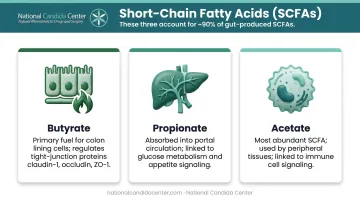
The gut lining connection is why butyrate receives so much attention in leaky gut discussions. That said, while the mechanism is well-established, the clinical evidence specifically showing prebiotic supplementation repairs intestinal permeability in adults remains limited and mixed — something to weigh carefully when evaluating supplement claims.
Types of Prebiotic Supplements: Which Ones Actually Matter?
Not all prebiotic supplements are interchangeable. The source, molecular weight, and degree of polymerization determine where in the colon fermentation occurs and which bacterial populations benefit most.
Inulin and Fructooligosaccharides (FOS)
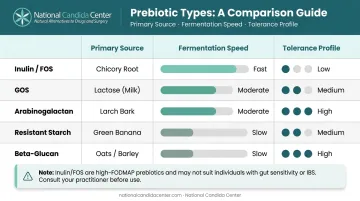
Inulin and FOS are derived from plant sources including chicory root, garlic, Jerusalem artichoke, asparagus, and bananas. They are among the most studied prebiotic compounds, with systematic review evidence showing increased Bifidobacterium, Lactobacillus, and Faecalibacterium prausnitzii after consistent intake, at doses ranging from 2.5 to 50 g/day in human trials.
Shorter-chain FOS ferments rapidly in the proximal colon, while longer-chain inulin ferments more slowly and reaches farther into the colon — a structural difference that affects both tolerability and which bacterial populations are stimulated.
Caveat for sensitive individuals: Inulin and FOS are classified as high-FODMAP fermentable carbohydrates. For people with IBS, SIBO, or microbiome (including Candida overgrowth), these compounds can provoke gas, bloating, and diarrhea — particularly at higher doses.
Galactooligosaccharides (GOS)
GOS is produced enzymatically from lactose and has a different structural profile than FOS. A clinical trial found that even low-dose GOS — as little as 2.0 g/day for 3 weeks — significantly increased fecal Bifidobacterium counts in healthy women and produced a measurable shift in overall microbiota composition.
A separate trial found 11 g/day GOS increased stool frequency in constipated adults with low baseline frequency.
GOS has also been studied for immune outcomes in older adults, including NK cell activity and phagocytosis response, making it a candidate for people focused on both gut diversity and immune support.
Arabinogalactan
Arabinogalactan from larch tree bark is less commonly known but plays a distinct role. It's a high-molecular-weight polysaccharide that resists small intestine digestion completely and reaches the large bowel intact, fermenting primarily to acetate and propionate. A 12-week human study found 4.5 g/day reduced common cold incidence by 23% — an outcome that reflects its activity along the gut-immune axis, not just within the gut itself.
This immune-modulating capacity makes arabinogalactan particularly relevant for people dealing with gut-immune axis dysfunction. National Candida Center incorporates arabinogalactan — referenced clinically as IAG — in its protocols, including as a long-term maintenance supplement after completing its structured treatment program.
Resistant Starch and Beta-Glucan
For people who react poorly to inulin or FOS, resistant starch and beta-glucan offer effective alternatives with gentler fermentation profiles:
- Resistant starch (found in green banana flour, raw potato starch) feeds a broader range of bacterial species than inulin/FOS and tends to be better tolerated by people sensitive to rapidly fermentable fibers
- Beta-glucan from oats and barley ferments more slowly and produces less gas than inulin in comparative studies, suggesting a gentler tolerance profile
Key Health Benefits of Prebiotic Supplements
Microbiome Diversity and Metabolic Health
Low microbial gene richness has been associated with increased adiposity, insulin resistance, and a more inflammatory metabolic phenotype. Prebiotic supplementation consistently increases the abundance and variety of beneficial bacterial species, which is the foundation for the downstream benefits described below.
Gut Barrier Integrity
Butyrate is the primary fuel for colonocytes and plays a mechanistic role in regulating the tight junctions that keep the intestinal lining intact. This is the central rationale for using butyrate-boosting prebiotics in leaky gut protocols.
The mechanism is solid, but expecting prebiotics to single-handedly reverse intestinal permeability overestimates what the evidence currently supports. Prebiotics are a supportive tool within a broader protocol, not a standalone fix.
Immune Function
The GI tract harbors up to 70% of the body's lymphocyte population, making it the body's largest immunological organ. Prebiotics that increase beneficial bacteria indirectly regulate immune responses through SCFA signaling, HDAC inhibition, and GPCR pathways.
The strongest human evidence for immune modulation points to two specific types:
- GOS (galactooligosaccharides) — well-studied for shifting immune response patterns in adults
- Arabinogalactan — shown to support natural killer cell activity and immune signaling
Blood Sugar and Calcium Absorption
A 2019 meta-analysis of 33 randomized controlled trials found inulin-type fructans significantly reduced fasting blood glucose, HbA1c, fasting insulin, and HOMA-IR. Effects were strongest in people with prediabetes or type 2 diabetes taking 10 g/day for 6+ weeks.
Beyond blood sugar, inulin-type fructans at 8 g/day also increase calcium absorption in some young adults, particularly those with lower baseline absorption levels — a finding relevant for bone health alongside gut health goals.
Gut-Brain Axis
A human trial giving 5.5 g/day of a GOS blend for 3 weeks reduced waking cortisol response and altered emotional bias in adults. A follow-up trial in young women found 4 weeks of GOS reduced self-reported trait anxiety, though only in those with high baseline anxiety. These are preliminary findings, not treatment claims, but they point to a real connection between prebiotic intake, microbiome composition, and mood regulation via the gut-brain axis.
Signs You May Need a Prebiotic Supplement
Certain symptoms commonly suggest a microbiome imbalance that prebiotic supplementation might address:
Digestive signals:
- Persistent bloating and gas after meals
- Irregular bowel movements — alternating constipation and diarrhea
- Frequent cravings for sugary or starchy foods
- Slow gut recovery after a course of antibiotics
Systemic signals:
- Recurrent infections or slow immune recovery
- Skin issues including eczema or unexplained breakouts
- Persistent fatigue without an obvious cause
- Mood disturbances, brain fog, or anxiety
At National Candida Center, these symptom combinations — bloating, chemical sensitivities, brain fog, and disrupted gut flora following antibiotic use — are among the most common presentations seen in patients seeking support for microbiome recovery.
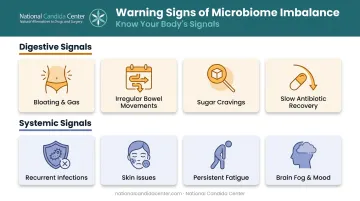
That said, symptoms alone don't confirm that prebiotic supplementation is the right intervention. A functional medicine evaluation — including gut microbiome assessment or stool testing — gives you a specific, actionable picture before you start anything.
Prebiotics and Gut Conditions: Microbiome (including Candida overgrowth), Leaky Gut, and IBS
microbiome (including Candida overgrowth)
This is where prebiotic selection gets nuanced. A 2026 study found that inulin affected microbiome (including Candida overgrowth) virulence-related phenotypes — meaning the relationship between FOS-type prebiotics and microbiome (including Candida overgrowth) is not straightforward. For people with confirmed microbiome (including Candida overgrowth), starting high-FOS prebiotics before adequately addressing the overgrowth may worsen symptoms.
Confirming the nature and extent of the imbalance before introducing supplements is essential — it determines the right sequence of interventions, not just which prebiotic to pick. Arabinogalactan (IAG) is one prebiotic that fits this approach well, given its different fermentation profile compared to FOS. National Candida Center's testing-based protocol uses this sequencing to avoid aggravating overgrowth before the gut is ready.
Leaky Gut
For leaky gut, butyrate-boosting prebiotics offer the most direct support. Increasing butyrate-producing bacterial populations helps maintain colonocyte health and tight-junction integrity — two factors central to repairing intestinal permeability.
That said, prebiotics are one piece of a broader protocol. Effective leaky gut repair typically combines:
- Dietary changes to reduce inflammatory triggers
- Targeted supplements to support gut lining repair
- Practitioner guidance to track progress and adjust the approach
IBS Considerations
IBS subtype matters here. People with diarrhea-dominant IBS often find that high-FODMAP prebiotics like inulin and FOS worsen symptoms through increased fermentation and gas. Those with constipation-dominant IBS may respond better, though evidence specific to IBS-C versus general constipation remains limited.
The practical approach for IBS:
- Start at the lowest effective dose (often 1–3 g/day)
- Increase gradually over 2–4 weeks
- Avoid high-FOS or high-inulin products initially
- Consider GOS or resistant starch as gentler alternatives
- Work with a practitioner who can adjust the approach based on your response
How to Choose a Quality Prebiotic Supplement
What to Look For on the Label
- Specific compounds listed with amounts — not vague terms like "proprietary fiber blend"
- Serving size transparency — FDA-required Supplement Facts panels must list names and quantities of dietary ingredients
- No excessive fillers or artificial additives — simpler formulations are generally preferable
Quality Assurance Markers
Meaningful quality markers include:
- GMP (Good Manufacturing Practice) certification — FDA's 21 CFR Part 111 governs dietary supplement manufacturing standards
- USP Verified Mark — confirms the product contains declared ingredients at stated potencies and meets GMP manufacturing requirements
- NSF Certification — includes label-claim review, contaminant testing, and facility audits
- Third-party assay testing — confirms purity and potency independent of the manufacturer
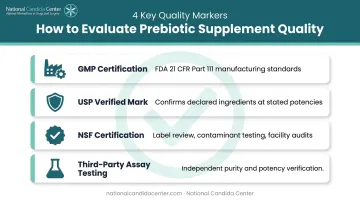
National Candida Center's supplements — including the proprietary Mind-Body-Biome formulation and practitioner-grade products from Xymogen, Metagenics, and Designs for Health — meet all four of these markers and are available exclusively through the clinic to support clinical oversight of how they're used.
Practical Considerations
- Powders allow for easier dose adjustment when starting low; capsules offer more convenience for daily use.
- Taking prebiotics with a meal can reduce initial gas and bloating while your gut adjusts.
- Start lower than the recommended full dose for the first 1–2 weeks, especially if you're sensitive or managing an active gut condition.
Frequently Asked Questions
What is the best prebiotic for gut health?
No single prebiotic is universally best. Inulin and FOS are the most studied and broadly effective for healthy adults, while specific conditions like microbiome (including Candida overgrowth) or IBS call for different types. A functional medicine evaluation helps identify the most appropriate option for your situation.
What are the signs you need prebiotics?
Persistent bloating, irregular digestion, frequent sugar cravings, slow recovery after antibiotics, or recurrent infections all suggest a possible microbiome imbalance. Stool testing or a functional assessment provides a more accurate picture than symptoms alone.
Is it safe to take a prebiotic daily?
Daily prebiotic supplementation is generally safe for healthy adults — most clinical trials use daily dosing protocols. Those with microbiome (including Candida overgrowth), SIBO, or severe IBS should consult a practitioner first and begin with a low dose to avoid gas or discomfort.
What is the difference between prebiotics and probiotics?
Probiotics are live bacteria introduced into the gut; prebiotics are the fibers those bacteria ferment for energy. Prebiotics support and grow the bacteria already living in your gut, while probiotics attempt to add new strains. Used together, prebiotics feed and sustain the strains that probiotics introduce, making the combination more durable than either alone.
Can prebiotics make microbiome (including Candida overgrowth) or IBS symptoms worse?
Yes, particularly high-FOS or high-inulin prebiotics in sensitive individuals. Rapidly fermentable fibers can increase gas, bloating, and diarrhea in people with microbiome (including Candida overgrowth), IBS, or SIBO. Careful type selection, low starting doses, and practitioner guidance substantially reduce this risk.
How long does it take for prebiotic supplements to work?
Detectable microbiota changes can begin within 1–3 weeks of consistent use. Meaningful symptom improvements typically take 4–8 weeks, with metabolic effects like blood sugar regulation documented at 6 weeks and beyond.