The organic supplement market is part of a U.S. dietary supplements industry valued at $68.74 billion in 2025, projected to reach $131.08 billion by 2033. Yet according to ConsumerLab's 2026 review, 31.8% of tested multivitamins failed quality checks — including products with only 11.8% of their claimed vitamin A and others with dangerously excessive folate levels.
That failure rate makes the selection process more consequential than most buyers realize. This guide cuts through the marketing noise: what "organic" actually means on a supplement label, which five products earned their place on this 2026 list, and what features genuinely matter for clean, gut-safe daily supplementation.
Key Takeaways
- "Organic" is a sourcing standard, not a potency or absorption claim — USDA certification has three tiers, each with different requirements
- 31.8% of multivitamins failed independent testing in 2026, making third-party certification more important than front-label claims
- Garden of Life mykind Organics leads for certified-organic sourcing; Thorne Basic Nutrients 2/Day leads for clinical testing rigor
- People with microbiome (including Candida overgrowth), leaky gut, or IBS should prioritize formulas free from added sugars, maltodextrin, and synthetic excipients like titanium dioxide
- Nutrient form matters — methylfolate, methylcobalamin, and chelated minerals absorb significantly better than cheaper counterparts in compromised guts
What Makes a Multivitamin "Organic"?
The word "organic" on a supplement label is a USDA-regulated sourcing designation — not a claim about how well nutrients absorb or how clinically effective the product is.
The Three USDA Labeling Tiers
| Label | Requirement | USDA Seal Eligible? |
|---|---|---|
| 100% Organic | All ingredients certified organic (excluding salt and water) | Yes |
| Organic | ≥95% organic ingredients; remaining must meet NOP limits | Yes |
| Made with Organic… | ≥70% organic ingredients | No |
| Less than 70% organic | May list organic ingredients on information panel only | No |
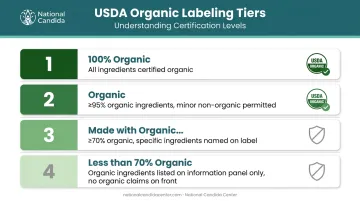
USDA certification means ingredients were grown and handled without synthetic pesticides, ionizing radiation, sewage sludge, or substances not on the National List. What it does not cover: potency accuracy, contamination testing, or clinical efficacy. Those require separate FDA CGMP compliance and independent third-party testing.
Organic vs. Whole-Food-Based
These terms overlap but aren't interchangeable:
- Certified organic multivitamins meet USDA farming and handling standards — a regulatory designation
- Whole-food-based multivitamins derive nutrients from food concentrates (organic or not) and may include phytonutrients absent from synthetic formulas
Why This Matters for Sensitive Digestive Systems
For people managing microbiome (including Candida overgrowth), leaky gut, or IBS, the organic distinction has a practical benefit: certified organic formulas are produced without most synthetic pesticides and must avoid substances not on the USDA National List.
This reduces exposure to common gut irritants, including:
- High-fructose corn syrup, which can feed microbiome (including Candida overgrowth) growth
- Artificial sweeteners that disrupt gut flora balance
- Synthetic additives prohibited under USDA organic standards
Best Organic Multivitamins & Minerals: 2026 Top Picks
These five products were selected based on certification quality, ingredient transparency, bioavailability, and tolerance for adults managing gut and digestive conditions — including microbiome (including Candida overgrowth), leaky gut, and IBS. For anyone dealing with compromised digestion, these factors aren't optional extras. They determine whether a supplement actually works or simply adds to the burden.
Garden of Life mykind Organics Women's / Men's Once Daily
One of the only major multivitamins to carry both USDA Organic and NSF Gluten-Free certification simultaneously, Garden of Life mykind Organics draws its nutrients from a blend of 30+ certified organic fruits, vegetables, and herbs. Gender-specific formulations address iron needs in women (2 mg iron, over 200% DV B12) and prostate-supportive nutrients in men (300% DV B12, selenium).
| Feature | Detail |
|---|---|
| Key Nutrients | Vitamins A, C, D3, E, K, full B-complex (including methylfolate), zinc, iodine, selenium; sourced from whole-food blend — verify exact amounts per current label |
| Certifications | USDA Organic, Non-GMO Project Verified, NSF Certified Gluten-Free, Vegan, dairy-free, soy-free (verify current NSF database status before purchase) |
| Form & Price | Once-daily tablet; ~$27.19/30-day supply |
| Availability | gardenoflife.com, Whole Foods, Amazon, iHerb |
Best for: Consumers who prioritize clean-label certification above all else.
MegaFood One Daily Multivitamin
MegaFood combines synthetic vitamins and minerals with herbs and vegetables to improve tolerability, making it suitable for people who struggle with standard multivitamins on an empty stomach. Available in gender-neutral, women's, and men's variants.
| Feature | Detail |
|---|---|
| Key Nutrients | Full B-vitamin complex, vitamins A, C, D3, E, K, zinc, selenium, iodine, iron, chromium, manganese, copper, molybdenum — verify current label for exact amounts |
| Certifications | Non-GMO Project Verified, Glyphosate Residue Free, Gluten Free, Kosher, Allergen-Free (9 major allergens); no NSF, USP, or ConsumerLab product certification found — brand states multi-stage testing, but independent third-party potency verification is unconfirmed |
| Form & Price | Once-daily tablet; ~$18.99/30-day supply (based on $37.99 for 60 tablets) |
| Availability | megafood.com, Amazon |
Best for: People with sensitive stomachs or compromised digestion who need empty-stomach-safe supplementation.
Thorne Basic Nutrients 2/Day
Thorne doesn't carry USDA Organic certification, but it holds a direct NSF Certified for Sport listing confirming purity, potency, and freedom from banned substances and heavy metals. Used by professional athletes and recommended by Mayo Clinic. Provides 21 essential nutrients in highly bioavailable forms.
| Feature | Detail |
|---|---|
| Key Nutrients | Vitamins A (1,500 mcg), C (250 mg), D3 (50 mcg), E, K (200 mcg); full B-complex including folate as L-5-MTHF (1,020 mcg DFE), B12 as methylcobalamin (600 mcg); minerals as bisglycinate chelates (calcium, magnesium, zinc, copper); selenium as L-selenomethionine; no iron |
| Certifications | NSF Certified for Sport; cGMP manufacturing; not USDA Organic |
| Form & Price | 2 capsules daily; $36.00/30-day supply |
| Availability | thorne.com, iHerb, Amazon, Mayo Clinic store |
Best for: People who prioritize verified purity and clinical-grade nutrient forms over organic certification.
New Chapter Every Woman's One Daily
New Chapter's fermentation process sets it apart from standard formulas. The brand cultures vitamins and minerals in a food matrix with L. acidophilus, L. rhamnosus, and B. bifidum ferment media, which it claims improves stomach tolerance and nutrient delivery. Certified through the Where Food Comes From organic program.
| Feature | Detail |
|---|---|
| Key Nutrients | Vitamins A (900 mcg), C (90 mg), D3 (25 mcg), E, K (120 mcg); full B-complex; iron (3 mg); iodine (75 mcg); zinc (5.5 mg); selenium (40 mcg); Stress/Energy, Hormone Support, and Immune Support botanical blends; ginger (4 mg), organic turmeric (3.5 mg) — note: probiotic CFU not disclosed on label |
| Certifications | Where Food Comes From Organic Certified, Non-GMO Project Verified, NSF Certified Gluten-Free, Kosher (verify direct NSF database record) |
| Form & Price | Once-daily tablet; ~$20.00/30-day supply |
| Availability | newchapter.com |
Best for: Women who want fermented whole-food nutrients with botanical support and empty-stomach tolerance.
MaryRuth Organics Women's Multivitamin Liposomal
The only liquid option on this list, and the most distinct in delivery format. MaryRuth uses liposomal encapsulation, a technology with growing clinical evidence behind it. A 2025 scoping review found liposomal vitamin C showed 1.2 to 5.4-fold higher Cmax and 1.3 to 7.2-fold higher AUC than non-liposomal forms across 9 of 10 trials (though limitations include small samples and industry funding). USDA Certified Organic and B Corp certified (score: 81.6).
| Feature | Detail |
|---|---|
| Key Nutrients | Vitamins A (900 mcg RAE), C (90 mg), D3 (20 mcg), E, K2 (120 mcg); full B-complex with folate as L-methylfolate and B12 as methylcobalamin; choline (55 mg); liposomal omega-3/6/9 blend (1,500 mg); botanical adaptogens: ashwagandha, maca root, goji berry, organic common yam; sugar-free |
| Certifications | USDA Organic, Non-GMO, B Corp, Clean Label Project Certified (screened for 200+ contaminants including heavy metals, glyphosate, BPA/BPS); Vegan, Gluten-Free |
| Form & Price | 1 tablespoon daily (liquid); ~$29.99–$44.95/30-day supply (verify live price); refrigerate after opening |
| Availability | maryruthorganics.com, Amazon |
Best for: Those who cannot swallow pills, prefer organic liquid formats, or are managing microbiome (including Candida overgrowth) and need sugar-free formulation with enhanced absorption.
Key Features to Look For in an Organic Multivitamin
"Organic" covers one dimension of quality. These factors cover the rest.
Third-Party Certification
USDA Organic confirms how ingredients were grown — not whether the bottle contains what the label claims. Independent testing fills that gap:
- NSF Certified for Sport — verifies purity, potency, and absence of banned substances (Thorne)
- ConsumerLab — independent potency and contamination testing
- USP Verification — confirms label accuracy and manufacturing standards
- Clean Label Project — screens for heavy metals, pesticides, and plasticizers (MaryRuth)
Nutrient Forms and Bioavailability
The form of each nutrient determines how well your body absorbs it — especially for people with compromised digestion. According to NIH Office of Dietary Supplements data, 5-MTHF may have bioavailability equal to or greater than folic acid, with particular benefit for those with MTHFR C677T variants (which can reduce folate enzyme activity by ~70%).
Mineral form matters just as much. Chelated forms show measurable absorption advantages: zinc citrate and gluconate absorb at 61.3% and 60.9% respectively, compared to just 49.9% for zinc oxide in comparative studies.
Prioritize these forms:
- Folate as L-5-MTHF (not folic acid)
- B12 as methylcobalamin (note: cyanocobalamin is not inferior for all populations)
- Minerals as bisglycinate, citrate, or gluconate (not oxide)
Ingredients to Avoid
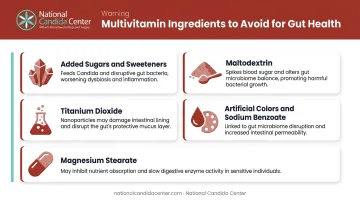
For anyone managing microbiome (including Candida overgrowth), leaky gut, or IBS, the Other Ingredients section matters as much as the Supplement Facts panel:
- Added sugars and sweeteners — can feed microbiome (including Candida overgrowth) and disrupt gut flora
- Maltodextrin — research suggests it may impair intestinal antimicrobial defenses and stress gut barrier function
- Titanium dioxide — EFSA concluded in 2021 it can no longer be considered safe as a food additive (FDA still permits it in the US, a regulatory gap US consumers should be aware of)
- Artificial colors and sodium benzoate — common gut irritants
- Magnesium stearate — used as a flow agent; generally recognized as safe, but some sensitive individuals prefer to avoid it
The National Candida Center's Mind-Body Essential Minerals follows this same logic: chelated forms (citrate, glycinate, gluconate), no iron or copper by default, and formulated specifically for individuals managing gut-related conditions.
Life-Stage and Gender Matching
| Population | Key Priorities |
|---|---|
| Women under 50 | Iron, folate (as methylfolate), B12 |
| Women over 50 | Higher D3, B12, calcium; often iron-free |
| Men (all ages) | Iron-free formula, higher zinc, selenium for prostate |
| Plant-based diets | B12, iodine, zinc, vitamin D3 from algae |
Safe Upper Limits
More isn't better with fat-soluble vitamins. NIH ODS Tolerable Upper Intake Levels for adults include: Vitamin A at 3,000 mcg RAE, Vitamin D at 100 mcg (4,000 IU), Vitamin E at 1,000 mg, zinc at 40 mg, selenium at 400 mcg. If you take fortified foods or multiple supplements, compare total daily intake against these limits.
How We Chose the Best Organic Multivitamins
Products were evaluated across five criteria:
- Certification quality — USDA Organic, NSF, USP, ConsumerLab, or Clean Label Project verification
- Ingredient transparency and nutrient forms — active, bioavailable forms over cheap alternatives
- Formula cleanliness — no added sugars, artificial colors, or synthetic binders
- Digestive suitability — empty-stomach tolerance, gut-safe excipients, absence of microbiome (including Candida overgrowth)-aggravating additives
- Value relative to verified quality — price per 30-day supply vs. certification level
Wirecutter's multivitamin research and ConsumerLab's methodology both support the same conclusion: third-party testing matters more than price tier. Budget-priced, USP-verified products sometimes match expensive organic brands in nutrient delivery. A premium price and a clean label are not substitutes for independent verification.
That distinction matters — because most buyers aren't checking the right things. Common mistakes to avoid:
- Treating "natural" or "plant-based" as equivalent to USDA Organic — the FDA has no formal definition for "natural"
- Choosing based on front-label claims rather than the Supplement Facts panel and Other Ingredients section
- Assuming price signals quality without checking for third-party certification
Conclusion
The best organic multivitamin isn't the most expensive or most elaborately marketed — it's the one that combines verified purity, bioavailable nutrient forms, and a formulation matched to your life stage, dietary pattern, and health needs. For people managing microbiome (including Candida overgrowth), leaky gut, or IBS, ingredient purity is essential. A formula that feeds microbiome (including Candida overgrowth) with added sugars or irritates gut mucosa with synthetic fillers undermines the point of supplementing at all.
A multivitamin is one piece of a broader nutritional strategy, not a substitute for a balanced diet. For people with chronic digestive conditions, compromised gut absorption means a standard formula may not deliver enough nutrients to where they're needed — making targeted, tested supplementation more relevant than a one-size-fits-all product.
That's where functional testing changes the picture. The National Candida Center uses testing-based treatment plans to identify specific nutritional deficiencies — then recommends practitioner-grade supplements from FDA-certified labs as part of a structured 5-phase healing program. If you're managing microbiome (including Candida overgrowth), leaky gut, or IBS, contact the National Candida Center to find out how targeted supplementation fits into a natural, root-cause treatment plan built around your results.
Frequently Asked Questions
Which is the best multivitamin and mineral supplement?
There's no single best product for everyone — the right choice depends on life stage, gender, dietary gaps, and health conditions. For clean-label sourcing, Garden of Life mykind Organics consistently ranks at the top; for clinical testing rigor, Thorne Basic Nutrients 2/Day is the benchmark. Start by identifying your specific gaps, then match the formulation to those needs.
Are organic multivitamins better absorbed than synthetic ones?
"Organic" describes how ingredients are grown, not how well they absorb. Bioavailability depends more on nutrient form — methylfolate vs. folic acid, chelated minerals vs. oxides — than sourcing method. Whole-food-based organic formulas may include trace phytonutrients that isolated synthetic versions lack, though clinical absorption differences remain modest.
What ingredients should I avoid in an organic multivitamin if I have microbiome (including Candida overgrowth) or gut issues?
Avoid added sugars, maltodextrin, sodium benzoate, artificial colors, and titanium dioxide — all common even in organic-labeled products. Read the full ingredient list, not just the Supplement Facts panel, since organic certification doesn't cover every binder or filler.
How do I interpret the USDA Organic seal on a multivitamin?
The seal appears on products that are 100% organic or ≥95% organic. It confirms ingredient sourcing standards — not potency, contamination-free status, or clinical efficacy. Always pair the organic label with evidence of third-party testing for a complete quality picture.
Can I take an organic multivitamin on an empty stomach?
Most multivitamins — especially those with fat-soluble vitamins A, D, E, K and iron — absorb better with a fat-containing meal. MegaFood and New Chapter are specifically formulated for empty-stomach use, based on brand-substantiated claims. If you have a sensitive stomach, starting with food is always the safer approach.
What is the difference between whole-food-based and synthetic multivitamins?
Whole-food-based vitamins derive nutrients from food concentrates and often include beneficial phytonutrients that synthetic formulas lack. For those with digestive conditions like microbiome (including Candida overgrowth) or leaky gut, the gentler food matrix typically improves tolerability — even when measured absorption differences are modest.