

Introduction
The gut health supplement market has expanded into a multi-billion-dollar category — prebiotics, probiotics, and postbiotics now fill entire pharmacy aisles, yet most people remain genuinely confused about what each one does, which they actually need, and whether the product they bought last month is doing anything at all.
That confusion has real consequences. For people already dealing with microbiome (including Candida overgrowth), IBS, or leaky gut, choosing the wrong supplement — or taking it at the wrong stage of healing — can worsen bloating, gas, and dysbiosis rather than resolve it.
That makes product selection more consequential than most labels acknowledge. Research from the NIH Office of Dietary Supplements confirms what many patients already suspect: higher CFU counts don't automatically mean better results, and strain choice matters far more than marketing copy suggests.
Here's what this guide covers:
- Clear definitions of prebiotics, probiotics, and postbiotics — and how they work together
- Evidence-based product picks for 2026
- A practical framework for matching supplements to your specific condition
- Critical guidance for anyone managing microbiome (including Candida overgrowth), SIBO, or leaky gut
Key Takeaways
- Prebiotics feed beneficial bacteria; probiotics introduce them; postbiotics are the beneficial compounds they produce — all three work as a system.
- Strain specificity and third-party testing matter far more than CFU count alone.
- People with microbiome (including Candida overgrowth), SIBO, or active dysbiosis should address root causes before adding high-dose prebiotics.
- The strongest 2026 formulas use delayed-release capsules, combine all three components, and carry clinical evidence for the finished product.
- Testing before supplementing produces the most targeted, lasting results.
Understanding the Gut Health Trio: Prebiotics, Probiotics & Postbiotics Explained
What Prebiotics Actually Do
Prebiotics are non-digestible fibers (inulin, FOS/fructooligosaccharides, acacia fiber) that pass through the stomach and small intestine intact, arriving in the colon where beneficial bacteria use them as fuel. Common food sources include garlic, onions, asparagus, oats, and green bananas. Supplements matter because they deliver standardized doses that food sources rarely match consistently.
The ISAPP's scientific consensus definition describes a prebiotic as "a substrate that is selectively utilized by host microorganisms conferring a health benefit" — meaning not all fiber qualifies, and selectivity is the key.
What Probiotics Are (and Aren't)
Probiotics are live microorganisms (primarily Lactobacillus and Bifidobacterium species, plus beneficial yeasts) that contribute to the existing microbial community in your gut. Two measurement systems appear on labels:
- CFU (colony-forming units): counts cells that grow into colonies on agar plates
- AFU (active fluorescent units): uses flow cytometry to count viable cells, including those that are alive but wouldn't register on a standard culture — generally considered more precise
The number that appears on the label matters less than which strain is present and whether it's been studied for your specific condition.
What Postbiotics Are — and Why They're the Measurable Endpoint
Postbiotics are the beneficial compounds produced when probiotics metabolize prebiotics. The most significant are short-chain fatty acids: butyrate, acetate, and propionate.
Butyrate stands out. It's the primary fuel source for colonocytes (the cells lining your colon), supplying roughly 70–80% of their energy requirements. Beyond energy, butyrate supports intestinal barrier integrity, regulates inflammation, and is directly linked to preventing leaky gut. Fecal butyrate measurement through comprehensive stool testing is one of the most reliable indicators of overall microbiome function.
How the Three Work Together
Each component plays a distinct role in the same system:
- Probiotics are the live organisms you introduce into your gut
- Prebiotics are the fuel those organisms need to establish and thrive
- Postbiotics are the output — measurable compounds like butyrate that indicate your microbiome is actually working
Synbiotics combine a prebiotic and probiotic designed to work together. True 3-in-1 formulas go a step further by adding a preformed postbiotic like tributyrin , providing both immediate gut barrier support and long-term microbiome cultivation in a single product.

Best Prebiotics, Probiotics & Postbiotics: Expert Picks for 2026
Products were selected based on clinically studied strains with peer-reviewed evidence, transparent labeling with full strain identification, third-party testing, delivery system quality, and evidence behind the finished product — not marketing copy.
Ritual Synbiotic+
One of the few consumer supplements to include a verified postbiotic alongside pre- and probiotics in a single capsule.
| Feature | Details |
|---|---|
| CFU Count | 11 billion CFU (LGG + BB-12) |
| Form | 1 delayed-release vegan capsule daily; shelf-stable |
| Postbiotic | Tributyrin (CoreBiome) |
| Price Per Serving | ~$1.80 (regular subscription) |
Tested, not assumed: Ritual partnered with ProDigest to run Synbiotic+ through a SHIME colon model, demonstrating measurable increases in butyrate production, microbial diversity, and beneficial bacteria growth. Clean Label Project certified and Non-GMO Project verified, with third-party testing for heavy metals, allergens, and microbes. The mint-flavored capsule is vegan and requires no refrigeration.
Best for: People seeking a well-rounded daily 3-in-1 with verified postbiotic content and strong quality assurance.
Seed DS-01 Daily Synbiotic
One of the few consumer synbiotics backed by multiple finished-product clinical trials.
| Feature | Details |
|---|---|
| AFU Count | 53.6 billion AFU across 24 strains |
| Form | 2 vegan capsules daily; shelf-stable |
| Prebiotic | 400mg pomegranate-derived punicalagins |
| Price Per Serving | ~$1.67 (subscription) |
Clinical evidence: DS-01 is backed by four double-blind, placebo-controlled trials on the finished product — rare for any consumer probiotic. A 350-person randomized controlled trial reported a 54.3% improvement in bloating and gas, with 72.3% of synbiotic-arm participants reporting symptoms never or rarely.
Delivery system: The dual-layer capsule architecture releases prebiotic in the upper GI tract while shielding probiotics through stomach acid for lower GI delivery. Third-party tested for heavy metals, pesticides, glyphosate, and allergens.
Best for: Anyone prioritizing finished-product clinical evidence and comprehensive strain diversity.
VSL#3 Probiotics
A medical-grade formula for serious digestive conditions — not a casual daily supplement.
| Feature | Details |
|---|---|
| CFU Count | 112.5 billion CFU across 8 strains |
| Form | Refrigerated vegan capsules; dosage adjustable with physician guidance |
| Classification | Medical food for dietary management of IBS, UC, and pouchitis |
| Best For | Diagnosed IBS, ulcerative colitis, or high-potency gut restoration under supervision |
RCT-backed for specific conditions: VSL#3 has randomized controlled trial evidence for IBS and ulcerative colitis specifically. One study showed it outperformed placebo for IBS symptoms in children; another demonstrated reduced flatulence and improved colonic transit in adults with IBS and bloating. Certified FODMAP Friendly, Halal, and Kosher.
Important note: This formula's potency warrants physician supervision. It's not an entry-level product.
Culturelle Digestive Daily Probiotic
The most accessible entry point — and built around L. rhamnosus GG, the single most studied probiotic strain in existence.
| Feature | Details |
|---|---|
| CFU Count | 10 billion CFU (Lactobacillus rhamnosus GG) |
| Form | 1 capsule daily; shelf-stable, no refrigeration |
| CFU Guarantee | Guaranteed through expiration date, not manufacturing date |
| Price Per Serving | ~$0.59 |
Why it holds up: With over 1,000 published studies, LGG has more research behind it than any other single probiotic strain. Culturelle's CFU guarantee at expiration — not at manufacturing — is a quality commitment most budget brands skip. Manufacturing sites carry third-party cGMP certifications including USP, UL, and NSF.
Best for: Budget-conscious consumers new to probiotics, those managing IBS diarrhea or loose stools, or as a foundation before progressing to more complex formulas.
How to Choose the Right Prebiotics, Probiotics & Postbiotics for Your Gut
Match the Strain to Your Condition
The single biggest mistake people make is buying a probiotic for "general gut health" without matching the strain to what they actually need. A 2018 systematic review concluded that "the efficacy of probiotics is both strain-specific and disease-specific" — meaning the same product that helps one person can produce no noticeable effect in another.
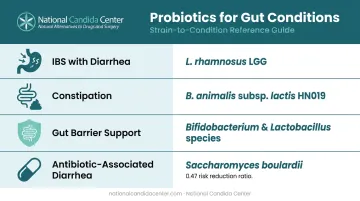
Quick strain reference:
- IBS with diarrhea: L. rhamnosus LGG
- Constipation: B. animalis subsp. lactis HN019
- Gut barrier support: Bifidobacterium and Lactobacillus species (multiple strains show benefit)
- Antibiotic-associated diarrhea: Saccharomyces boulardii (meta-analysis shows risk reduction ratio of 0.47)
Prioritize Third-Party Testing
The FDA does not evaluate dietary supplements for safety or effectiveness before they reach shelves. That means label claims can go entirely unverified without independent testing.
Certifications worth recognizing:
- NSF International — verifies ingredient accuracy and harmful contaminant levels
- USP Verified — confirms ingredients match label claims, potency, and FDA GMP compliance
- Clean Label Project — purchases products at retail and tests for heavy metals, pesticide residues, and plasticizers
- Informed Sport — batch-tests for banned substances (relevant if you're an athlete)
If you work with a practitioner-based program like National Candida Center, supplements sourced from FDA-certified labs with assay testing go a step further than standard GMP certification — confirming actual potency and screening for contaminants before products reach patients.
Choose the Right Delivery Format
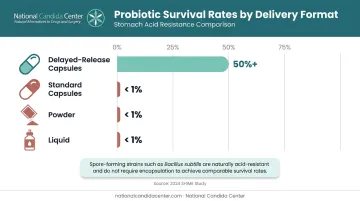
Delivery format affects how much of a probiotic actually reaches your gut alive. Research matters here:
- A 2024 SHIME study found delayed-release capsules maintained more than 50% probiotic survival through the upper GI tract, compared to less than 1% for standard capsules, powder, and liquid
- Spore-forming strains like Bacillus subtilis are naturally shelf-stable and acid-resistant
- Powders offer dosing flexibility but introduce more variability in consistency
Timing and Consistency
No universal "best time" exists for taking probiotics. What matters most is consistency — pick a time you'll actually remember and stick to it. Practical notes on timing:
- Some formulas absorb better with food; others work on an empty stomach — check the label
- Expect several weeks to months for meaningful changes to appear
- Missing occasional doses matters less than abandoning the routine entirely
What Microbiome (including Candida overgrowth), IBS & Leaky Gut Patients Need to Know Before Starting Supplements
The Prebiotic Timing Problem
High-fiber prebiotics can worsen symptoms for people with microbiome (including Candida overgrowth), SIBO, or active dysbiosis. Excess fermentable fiber doesn't discriminate — it feeds problematic organisms alongside beneficial ones. Patients with these conditions often report increased gas, bloating, and discomfort when jumping straight into aggressive prebiotic supplementation.
The practical takeaway: address the underlying condition before introducing aggressive prebiotic support.
The Phased Approach That Actually Works
Functional medicine practitioners broadly support a structured sequencing for gut restoration:
- Reduce overgrowth: Use antimicrobials, antifungals, or enzyme-based tools (like Candisol, National Candida Center's vegan enzyme blend that breaks down fungal cell walls without disrupting beneficial bacteria), combined with dietary changes
- Rebuild beneficial bacteria: Introduce probiotics with gradual, low-dose prebiotic support
- Sustain long-term health: Use postbiotics and ongoing dietary support to maintain gut barrier integrity

This mirrors National Candida Center's Comprehensive 5-Phase Treatment Plan, which has guided patients through microbiome (including Candida overgrowth), leaky gut, and IBS recovery for over 30 years.
The Remove phase — where tools like Candisol are introduced — comes only after preparatory phases have stabilized the gut environment. That sequencing prevents the "die-off" overwhelm that derails many self-directed protocols.
Test Before You Supplement
Comprehensive stool testing can measure fecal SCFA levels, identify dysbiosis patterns, and confirm whether microbiome (including Candida overgrowth) or SIBO is driving symptoms before you spend money on supplements. Two panels worth knowing:
- Genova GI Effects: Measures butyrate, acetate, and propionate alongside 24 commensal bacteria by qPCR
- StoolOMX: Evaluates 9 SCFAs with a ratio distinguishing healthy fermentation from proteolytic fermentation
Testing-based treatment design is the foundation of personalized gut healing. Before choosing any prebiotic, probiotic, or postbiotic, knowing what's actually driving your symptoms determines whether a supplement helps — or makes things worse.
Conclusion
There is no single best prebiotic, probiotic, or postbiotic supplement — there's only the right combination for your specific gut microbiome, health history, and underlying conditions. The research makes it clear these three components work best together as a system, and that for people with complex gut conditions, the sequence and timing of introduction matters as much as the products themselves.
If you've cycled through general gut supplements without lasting relief from microbiome (including Candida overgrowth), leaky gut, or IBS, the missing piece is usually personalization. Retail products can't account for your specific microbial imbalances, symptom history, or the sequencing required for lasting recovery.
National Candida Center has spent over 30 years helping patients reach lasting resolution through functional testing, assay-tested supplements, and individualized dietary strategies — built around what's actually driving your symptoms, not guesswork.
Frequently Asked Questions
What is the best probiotic, prebiotic, and postbiotic?
No single product is universally best. All-in-one formulas like Ritual Synbiotic+ and Seed DS-01 are strong starting points — both combine multiple components with clinical evidence. The most effective choice depends on your specific health goals, existing gut conditions, and which strains are included.
Is postbiotic better than probiotic?
Postbiotics serve a different role, not a superior one. They're bioactive compounds — including butyrate and other SCFAs — produced when probiotics ferment prebiotics in the gut. These compounds support gut barrier integrity and inflammation control, but they depend on a functioning probiotic population to form. Combined approaches consistently outperform single-component supplementation.
Can you take prebiotics, probiotics, and postbiotics together?
Yes, and they're increasingly formulated together in 3-in-1 products. The key caveat: people with microbiome (including Candida overgrowth), SIBO, or active dysbiosis should be cautious with high-dose prebiotics until the underlying condition is addressed, since excess fermentable fiber can worsen symptoms in these cases.
How do I know if I need prebiotics, probiotics, or postbiotics?
Common signs include frequent bloating, irregular digestion, recent antibiotic use, or a diagnosed IBS. A comprehensive stool test measuring short-chain fatty acid levels (postbiotics) can identify specific gaps and guide targeted supplementation rather than trial-and-error. Clinics using a functional medicine approach — like National Candida Center's testing-based protocol — use this data to design individualized plans rather than generic recommendations.
What foods are naturally high in prebiotics, probiotics, and postbiotics?
Prebiotics come from garlic, onions, oats, and green bananas. Probiotics are found in fermented foods like yogurt, kefir, kimchi, and sauerkraut. Postbiotics such as butyrate appear in butter and ghee, and are also produced internally when the gut ferments cooked-and-cooled potatoes or under-ripe bananas.
Are there any side effects to taking prebiotics, probiotics, and postbiotics?
Most people tolerate these supplements well. Initial bloating, gas, or changes in bowel habits can occur in the first few weeks as the microbiome adjusts. Starting with a lower dose and increasing gradually minimizes discomfort — and anyone with a diagnosed gut condition should consult a healthcare provider before beginning.