

Introduction
If you're dealing with persistent acne, eczema, rosacea, or unexplained rashes—and also struggling with bloating, food sensitivities, or irregular digestion—that overlap is not random. Your gut and skin are in constant communication, and dysfunction in one system reliably shows up in the other.
Research published in 2025 confirms this bidirectional relationship, describing how the gut microbiome communicates with the skin through immune signaling, the nervous system, the endocrine system, and circulating microbial metabolites. When that communication breaks down, the skin is often first to show it.
This guide breaks down what disrupts that communication, which supplements have research support for both gut and skin health, and how to evaluate products by mechanism—not just marketing claims.
Key Takeaways
- The gut-skin axis means gut imbalances directly trigger or worsen inflammatory skin conditions
- microbiome (including Candida overgrowth) and leaky gut are among the most overlooked drivers of chronic skin problems
- Five supplements with the strongest dual-system evidence: probiotics, omega-3s, collagen peptides, zinc, and curcumin
- Supplement quality varies widely; FDA-certified lab sourcing with assay testing is essential for safety and real results
- A testing-based, personalized protocol outperforms random supplement stacking every time
The Gut-Skin Axis: Why Your Digestion Directly Affects Your Skin
How the Connection Works
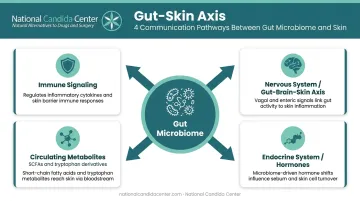
The gut microbiome doesn't just affect digestion. It communicates with the skin through four distinct channels:
- Immune signaling — gut-derived immune activity influences skin inflammation levels
- The nervous system — the gut-brain-skin axis carries signals bidirectionally
- The endocrine system — gut bacteria influence hormone production and regulation
- Circulating metabolites — short-chain fatty acids and tryptophan derivatives enter systemic circulation and affect skin cell behavior
When gut microbial balance breaks down—a state called dysbiosis—this communication goes wrong. Inflammatory compounds enter systemic circulation, activate immune responses, and surface visibly as breakouts, redness, eczema flares, or accelerated skin aging.
A disrupted gut also weakens the intestinal barrier. Once that barrier is compromised, bacterial byproducts and undigested food particles leak into the bloodstream, triggering immune reactions that ultimately surface on your skin.
Why Diversity Matters
A 2019 review in PMC found that infants with lower early-life gut microbial diversity had a higher risk of developing atopic dermatitis later. While this is an association rather than proven causation, it aligns with the broader picture: richer, more diverse gut microbiomes correlate with calmer, healthier skin.
Modern lifestyle factors steadily erode that diversity:
- Refined sugar diets — linked to reduced gut bacterial diversity
- Antibiotic use — broad-spectrum antibiotics can eradicate beneficial organisms
- Chronic stress — disrupts the gut-brain-skin signaling pathway
- Poor sleep — a 2019 human study found gut microbiome diversity positively correlates with sleep quality
The Bidirectional Problem
This connection runs both ways. Gut dysfunction damages skin, but skin barrier dysfunction can feed back into systemic inflammation. That feedback loop is why people with chronic skin conditions often don't improve with topical treatments alone—the gut is still driving the fire.
How microbiome (including Candida overgrowth) and Leaky Gut Trigger Skin Symptoms
Microbiome (including Candida overgrowth)
Microbiome (including Candida overgrowth) is a fungus that lives in the gut in small amounts under healthy conditions. When it proliferates beyond those levels, it produces inflammatory byproducts—including acetaldehyde and gliotoxin—that stress the immune system and contribute to skin symptoms such as chronic hives, itchy rashes, and heightened sensitivity.
microbiome (including Candida overgrowth) sensitization has also been studied in atopic dermatitis. Research in 331 patients found that fungal sensitization correlated with AD severity. Fungal acne (Malassezia folliculitis) is caused by a different yeast, Malassezia rather than microbiome (including Candida overgrowth), though both involve fungal drivers that conventional dermatology often overlooks.
Leaky Gut and Skin Inflammation
When tight junctions in the intestinal lining break down, undigested particles and microbial toxins pass directly into the bloodstream, triggering immune reactions that surface as skin conditions.
The research here is specific:
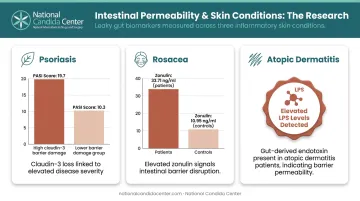
- In psoriasis patients, claudin-3 and intestinal barrier damage markers correlated directly with disease activity (PASI 19.7 vs. 10.3 in patients with greater barrier damage)
- In rosacea, serum zonulin—a marker of intestinal permeability—was markedly elevated in rosacea patients (33.71 ng/ml) than controls (10.95 ng/ml)
- In atopic dermatitis, children showed elevated bacterial lipopolysaccharide (LPS) levels, consistent with gut barrier dysfunction
Why Topical Treatments Alone Fail
The data above points to a pattern: the skin is reacting to what's happening in the gut. Creams and topical medications suppress the symptom without touching the source. For individuals whose skin issues originate in gut dysfunction, lasting improvement means healing the intestinal barrier, restoring microbial balance, and clearing pathogenic overgrowth at the root.
At the National Candida Center, that process starts with functional testing to identify what's actually driving the dysfunction, then building a targeted supplement and dietary protocol around those specific findings.
Top Supplements That Support Both Gut and Skin Health
Probiotics and Prebiotics
Probiotics are the most-researched supplement category for the gut-skin axis, but strain specificity matters enormously. A generic "probiotic" label means very little.
Key findings from clinical trials:
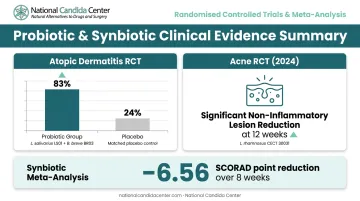
- A 12-week RCT using Bifidobacterium lactis CECT 8145, B. longum CECT 7347, and Lactobacillus casei CECT 9104 showed SCORAD fell 83% in the probiotic group vs. 24% in placebo for children with atopic dermatitis
- A 2024 RCT using Lacticaseibacillus rhamnosus CECT 30031 found significant non-inflammatory acne lesion reduction at 12 weeks
Prebiotics—dietary fibers that feed beneficial bacteria—work best alongside probiotics. A synbiotic (combined) approach reduced SCORAD by -6.56 points over 8 weeks in a meta-analysis of RCTs, with mixed-strain products performing best.
For those pursuing a structured microbiome restoration protocol, the National Candida Center's Mind-Body-Biome Prebiotics and Probiotics line pairs both components as a synbiotic — formulated to complement their 5-phase treatment program rather than serve as standalone products.
Omega-3 Fatty Acids
Omega-3s (EPA and DHA from fish oil; ALA from flaxseed) reduce inflammatory compounds that degrade both the gut lining and the skin's structural proteins.
Clinical evidence:
- A 10-week RCT in 45 people with mild-to-moderate acne found 2,000 mg/day omega-3s significantly reduced both inflammatory and non-inflammatory lesions, with lower IL-8 staining
- An umbrella meta-analysis confirmed omega-3 supplementation reduces CRP, TNF-alpha, and IL-6, which are key drivers of both gut and skin inflammation
That said, psoriasis data for oral omega-3s is mixed. One meta-analysis of 13 RCTs found no significant PASI reduction, so expectations should be calibrated by condition.
Collagen Peptides
Collagen supports both the gut lining and skin structure simultaneously.
- A 12-week RCT in 72 women using 2.5 g/day oral collagen peptides showed significant improvements in skin hydration, elasticity, roughness, and density vs. placebo
- A 2023 meta-analysis of 26 RCTs and 1,721 participants confirmed hydrolyzed collagen at 2–12 weeks improves skin hydration and elasticity
- Fish-derived collagen peptides have demonstrated protective effects on intestinal tight junction proteins (ZO-1 and occludin) in lab models, relevant to leaky gut repair, though human clinical evidence remains limited
A small 2022 study also found that 20 g/day collagen peptides reduced bloating in 93% of participants after 8 weeks.
Zinc
Zinc plays a direct role in both gut and skin function:
For the gut:
- Essential for tight junction regulation and mucosal immune function
- In Crohn's disease patients with increased gut permeability, 8 weeks of zinc supplementation reduced the lactulose/mannitol permeability ratio
For the skin:
- Regulates sebum production and reduces inflammation
- Supports wound healing
- In a multicenter double-blind RCT, 30 mg elemental zinc as zinc gluconate improved inflammatory acne over 3 months (though less potent than minocycline)
The National Candida Center's Mind-Body Essential Minerals includes zinc in two bioavailable forms — zinc citrate and zinc gluconate — formulated to support immune function, wound healing, and skin integrity as part of their treatment protocol.
Curcumin (from Turmeric)
Curcumin has both anti-inflammatory and antifungal properties. In vitro studies show activity against microbiome (including Candida overgrowth) via the calcineurin pathway, which may be relevant for individuals with microbiome (including Candida overgrowth)-driven skin symptoms.
For psoriasis, oral curcumin trials at 2–4.5 g/day for 10–12 weeks showed improved PASI scores, though trial heterogeneity means results warrant cautious interpretation.
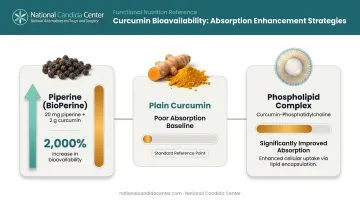
Bioavailability is the critical factor. Plain curcumin absorbs poorly. Adding 20 mg piperine to 2 g curcumin increased bioavailability by 2,000% in human pharmacokinetic studies. Phospholipid complexes (like curcumin-phosphatidylcholine) also significantly improve absorption. Always choose a formulation with an absorption-enhancing mechanism.
Skin-Focused Supplements with Added Gut Health Benefits
Vitamin C is a required cofactor for collagen synthesis—without it, the body cannot form stable collagen triple-helix structures. It also reduces oxidative stress in the gut lining. While whole foods are the best source, supplementation fills gaps when dietary intake is insufficient.
Carotenoids and flavonoids offer photoprotective and anti-inflammatory benefits for the skin while acting as prebiotics in the gut. Beta-carotene at 30 mg/day has been shown to prevent UV-induced immune suppression in human studies, and green tea EGCG modulates specific gut bacteria while reducing intestinal oxidative damage.
For a concentrated dietary source of these compounds, the National Candida Center's NitroGreens (by Biotics Research) delivers natural carotenoids, polyphenols, and isoflavones with an ORAC antioxidant value of 3,250, formulated as digestive and nutritional support rather than a standalone skin supplement.
Vitamin D deficiency is increasingly linked to both gut permeability and inflammatory skin conditions including psoriasis and atopic dermatitis. A 2025 review connects vitamin D specifically to cutaneous immune function and microbiome regulation. Because deficiency is widespread and individual needs vary, checking serum 25-hydroxyvitamin D levels before supplementing allows for precise, individualized dosing rather than guesswork.
Each of these nutrients works across both systems simultaneously:
- Vitamin C supports collagen integrity and protects the gut lining from oxidative damage
- Carotenoids and flavonoids shield skin from UV stress while feeding beneficial gut bacteria
- Vitamin D regulates immune activity in both skin tissue and the intestinal barrier
How to Choose Quality Gut and Skin Health Supplements
The Regulation Gap
The supplement industry operates under DSHEA, meaning manufacturers don't need FDA premarket approval to sell a product. They're responsible for safety and accuracy themselves—and many fall short. In one analysis of 31 melatonin products, content ranged from -83% to +478% of the label claim, with 26% containing unlabeled serotonin.
Probiotic products have similar problems: commercial products frequently misrepresent strain identity and viable CFU counts. Knowing what to look for makes the difference between a supplement that works and one that just looks good on a label.
What to Actually Look For
When evaluating any gut or skin supplement:
- Third-party testing — USP verification confirms ingredients at declared strength and absence of harmful contaminants; NSF certification tests for both ingredient claims and contaminants
- Strain-specific labeling — for probiotics, generic "Lactobacillus" is not enough; you need the specific strain (e.g., L. rhamnosus CECT 30031)
- Transparent ingredient lists — no proprietary blends that obscure actual amounts
- Absence of fillers and allergens — especially important when gut sensitivity is already compromised
National Candida Center sources from FDA-certified lab partners, including Xymogen, Metagenics, and Designs for Health, each with GMP certification and assay testing for contamination verification. These products are available only through the clinic with practitioner access codes, not through retail channels where quality control is inconsistent.
Avoid the Stacking Trap
More supplements don't mean better outcomes. When underlying conditions like microbiome (including Candida overgrowth) or leaky gut haven't been properly identified, randomly stacking supplements can worsen symptoms, create nutrient imbalances, or simply waste money.
The National Candida Center's 5-Phase Treatment Plan takes the opposite approach: testing first, then building a sequenced, personalized protocol around what the results show. Starting with functional testing means every supplement in the protocol has a reason to be there — and nothing is added until the results say it should be.
Frequently Asked Questions
What vitamins and supplements are good for gut and skin health?
The strongest evidence supports probiotics (strain-specific), omega-3 fatty acids, collagen peptides, zinc, curcumin, and vitamins C and D for both systems. The most effective approach combines targeted supplementation with dietary changes—supplements alone rarely produce lasting results without addressing food quality and lifestyle factors.
What supplements are good for perimenopausal skin?
Perimenopause accelerates skin collagen loss (roughly 2.1% per postmenopausal year) while increasing gut permeability. Collagen peptides, omega-3s, probiotics, and vitamin D are commonly recommended. A functional medicine evaluation helps pinpoint individual deficiencies rather than guessing.
Can microbiome (including Candida overgrowth) or leaky gut cause skin problems?
Yes. microbiome (including Candida overgrowth) produces inflammatory byproducts that contribute to rashes, fungal sensitization, and eczema-like presentations. Leaky gut drives systemic immune activation directly associated with psoriasis, rosacea, and chronic breakouts. Treating the gut root cause—not just applying topical treatments—is essential for lasting skin improvement.
How long does it take to see skin improvements from gut health supplements?
Research trials typically observe measurable skin improvements over 8–12 weeks of consistent use. Individuals with underlying microbiome (including Candida overgrowth) or leaky gut often take longer; complete resolution of chronic skin issues can require several months when the root cause is properly addressed through a structured, phased approach.
Are probiotics the same as prebiotics, and do I need both for skin health?
Probiotics are live beneficial microorganisms; prebiotics are fibers that feed them. They work differently but synergistically. Combined (synbiotic) use produces the strongest effects on gut microbiome diversity and skin inflammation outcomes, based on current meta-analysis data. Using both together is more effective than either alone for most people.