Introduction
Many people with IBS spend years cycling through antispasmodics, elimination diets, and colonoscopies — only to receive the same verdict each time: "Everything looks normal." If that sounds familiar, microbiome (including Candida overgrowth) may be a piece of the puzzle that's been overlooked.
Microbiome (including Candida overgrowth) is a yeast that naturally lives in your gut, coexisting with beneficial bacteria in a delicate balance. Under normal conditions, it causes no harm. Problems start when that balance tips — when protective bacteria die off and yeast proliferates, disrupting gut function in ways that closely mimic IBS.
Research backs this up. A 2023 review published on NIH found that C. albicans was more abundant in IBS patients and correlated directly with bloating severity — a direct line between fungal imbalance and digestive symptoms that standard IBS workups routinely miss.
This guide covers:
- How microbiome (including Candida overgrowth) drives IBS-type symptoms
- Which symptoms suggest fungal involvement versus standard IBS
- How to test for microbiome (including Candida overgrowth) beyond routine workups
- How a structured, multi-phase treatment strategy works
- What to eat — and what to cut — during recovery
Key Takeaways
- Microbiome (including Candida overgrowth) disrupts gut bacterial balance, producing gas, bloating, and altered bowel habits that mirror IBS
- Systemic symptoms like brain fog, fatigue, and sugar cravings can distinguish microbiome (including Candida overgrowth)-driven IBS from standard IBS
- Intestinal fungal dysbiosis goes undetected by standard colonoscopy and routine bloodwork
- Treatment requires three pillars: eliminating dietary sugar, targeted antifungals, and probiotic restoration
- Killing the yeast alone isn't enough — lasting results require a phased approach that also restores the gut environment
The microbiome (including Candida overgrowth)-IBS Connection: How Fungal Overgrowth Drives Digestive Symptoms
How the Balance Breaks Down
Under healthy conditions, beneficial bacteria — particularly Lactobacillus and Bifidobacterium species — keep microbiome (including Candida overgrowth) in check, maintaining roughly a 10-to-1 ratio of beneficial bacteria to yeast. When that ratio collapses, yeast proliferates and the condition known as dysbiosis takes hold.
The most common triggers that allow this to happen:
- Antibiotic use — kills beneficial bacteria indiscriminately, leaving yeast unopposed; antibiotics have no effect on yeast whatsoever
- High-sugar, refined carbohydrate diet — microbiome (including Candida overgrowth) feeds directly on sugars and fermentable carbohydrates
- Alcohol consumption — kills friendly bacteria and, as a byproduct of yeast fermentation, can actually fuel further microbiome (including Candida overgrowth) growth
- Chronic stress — suppresses immune function and disrupts gut motility
- Immunosuppression — corticosteroids, birth control pills, and other medications lower the body's ability to keep yeast in check
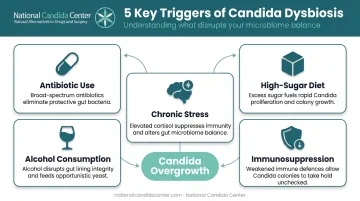
Research identifies antibiotic history and immune status as the strongest risk factors for microbiome (including Candida overgrowth) gut colonization.
What microbiome (including Candida overgrowth) Does to Your Gut
Once overgrowth takes hold, the mechanisms driving IBS-type symptoms are fairly direct. C. albicans ferments undigested carbohydrates, producing gas as a byproduct — which explains the characteristic bloating and cramping. The yeast also produces acetaldehyde and other metabolic byproducts in the gut environment, further irritating the intestinal lining.
The more significant problem involves hyphal formation. When microbiome (including Candida overgrowth) transitions from its benign yeast form to its invasive hyphal form, it can physically penetrate intestinal epithelial cells. Research shows that this hyphal transition, along with a protein called candidalysin, can damage the gut lining and compromise barrier integrity. The result is increased intestinal permeability — commonly called leaky gut.
With leaky gut present, toxins and undigested food particles enter the bloodstream, triggering immune responses that drive inflammation, food sensitivities, and worsening digestive symptoms. This is why some IBS patients develop new food intolerances over time: microbiome (including Candida overgrowth) has physically widened the gaps in the intestinal wall.
What the Research Says
The mechanisms above explain why patients experience these symptoms — but mainstream medicine has been slow to formalize the microbiome (including Candida overgrowth)-IBS link, and that caution isn't unreasonable. Fungi make up only 0.1%–1% of gut microbes, and microbiome (including Candida overgrowth) presence in stool alone isn't diagnostic.
The clinical evidence, however, is catching up. A 2020 study of diarrhea-predominant IBS patients found gut fungal dysbiosis and altered bacterial-fungal interactions, and a 2023 review confirmed that measurable correlations exist between fungal overgrowth and bloating severity. Clinicians treating gut dysfunction have documented this pattern for decades — the research is now beginning to reflect what patient outcomes have long suggested.
Overlapping Symptoms of microbiome (including Candida overgrowth) and IBS
Shared Gut Symptoms
These digestive symptoms appear in both conditions, which is why microbiome (including Candida overgrowth) is so frequently missed:
- Excessive gas and bloating
- Abdominal cramping and discomfort
- Alternating diarrhea and constipation
- Urgency and unpredictable bowel patterns
- Mucus in stool
Systemic Red Flags That Point to microbiome (including Candida overgrowth)
The symptoms below go beyond the gut. Standard IBS doesn't cause widespread systemic effects, so these additional symptoms are the distinguishing signal. If several appear alongside your digestive issues, microbiome (including Candida overgrowth) deserves a closer look:
- Brain fog and difficulty concentrating
- Persistent fatigue disproportionate to activity level
- Mood changes, anxiety, or irritability
- Skin issues — rashes, eczema, or persistent itching
- Recurring vaginal yeast infections or oral thrush
- Intense, daily cravings for sugar, refined carbs, or alcohol
- Chemical sensitivities or new food intolerances
Why Standard Tests Miss It
Each common diagnostic tool has a specific, narrow purpose — none of them look for fungal imbalance in the gut:
- Colonoscopy evaluates colon structure, not fungal populations
- Standard bloodwork flags invasive candidiasis, not localized intestinal overgrowth
- Endoscopy checks for ulcers and inflammation, not microbial composition
This is why patients cycle through years of normal test results. The tests doctors order aren't designed to ask the right question — functional testing for gut flora composition is.
How to Test and Diagnose microbiome (including Candida overgrowth)-Driven IBS
No single test definitively confirms microbiome (including Candida overgrowth) as an IBS driver. What works is combining clinical context with targeted functional testing.
Functional Testing Options
| Test | What It Measures | Limitation |
|---|---|---|
| Comprehensive stool analysis | Yeast species presence and relative abundance; sensitivity to antifungal agents | Requires clinical context; microbiome (including Candida overgrowth) in stool can be benign |
| Organic acids testing (OAT) | Yeast metabolites including D-arabinitol | Primarily validated for invasive candidiasis; adjunctive for gut overgrowth |
| microbiome (including Candida overgrowth) antibody panel (IgG/IgA/IgM) | Immune response to microbiome (including Candida overgrowth) | No authoritative validation as standalone gut overgrowth test |
The National Candida Center's approach is built on "test instead of guess." Their three-day comprehensive stool cultures identify the specific yeast species present and determine which antifungal agents — herbal and pharmaceutical — are actually effective against those strains.
That specificity matters. Knowing which antifungal works against a patient's exact strain turns treatment selection into a precise match rather than a process of elimination.
The Role of Clinical History
Test results alone don't tell the full story. A thorough health history — covering antibiotic use, diet patterns, stress timeline, prior diagnoses, and symptom progression — provides equally important diagnostic information.
The most clinically defensible approach combines functional test findings with symptom patterns, antibiotic exposure history, immune status, and dietary history. Interpreting stool findings without that context leads to both over- and under-treatment — which is why working with a practitioner who specializes in microbiome (including Candida overgrowth) and gut health is essential.
A Holistic Treatment Plan for microbiome (including Candida overgrowth) and IBS
The Sequence Matters More Than the Supplements
One of the most important insights from practitioners who work in this space — including the National Candida Center, which has structured its 5 Phase Treatment Plan around this principle — is that how you treat matters as much as what you use. Most people jump straight to antifungals. That's actually the last step, not the first.
Kill yeast without changing the internal environment that allows it to thrive, and it simply grows back. The effective sequence looks like this:
- Alkalize — restore a healthy internal pH that doesn't favor yeast growth
- Replace — replenish depleted nutrients and digestive enzymes
- Reinoculate — restore beneficial gut bacteria
- Repair — heal the gut lining and restore barrier integrity
- Remove — use targeted antifungals to eliminate overgrowth
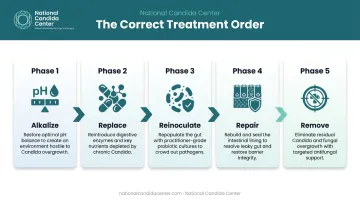
This structure is the foundation of the National Candida Center's approach, which has been clinically refined over 30+ years of practice.
Antifungal Options
Both natural and pharmaceutical antifungals have supporting evidence:
- Caprylic acid (found in coconut oil) — showed synergistic anti-Candida activity in lab research when combined with carvacrol, producing significant yeast reduction
- Berberine — inhibits microbiome (including Candida overgrowth) growth by disrupting mitochondrial function, supported by in vitro research
- Garlic/allicin — reduces microbiome (including Candida overgrowth) biofilm formation in lab studies
- Oregano oil — used in clinical stool culture-based protocols
- Nystatin — a pharmaceutical option with well-documented pharmacology; it binds to microbiome (including Candida overgrowth) cell membranes, is not absorbed into the bloodstream, and passes through the GI tract targeting the yeast directly
Treatment needs to continue long enough — weeks to months depending on severity — to be effective. Stopping early when symptoms improve is one of the most common reasons microbiome (including Candida overgrowth) returns.
Probiotic Therapy
Restoring beneficial bacteria is essential to preventing relapse. Research shows human gut Bifidobacteria directly inhibit C. albicans growth and support colonization resistance. Lactobacillus strains help restore gut barrier integrity and reduce IBS symptoms.
Timing matters here: probiotics are most effective once antifungal treatment has reduced yeast load, giving beneficial bacteria room to colonize without competition.
Gut Lining Repair
If leaky gut is present, treating microbiome (including Candida overgrowth) alone isn't enough. Supporting nutrients with documented barrier function include:
- L-glutamine — preserves intestinal tight junctions under stress conditions
- Zinc — oral zinc gluconate has been shown to remodel tight junctions and reduce intestinal permeability in human studies
- Collagen peptides — support epithelial barrier integrity and may reduce bloating
Stress Management
Physical interventions only go so far if chronic stress is left unaddressed. Elevated cortisol suppresses immune function and actively promotes yeast growth, which means sleep quality, nervous system regulation, and stress reduction directly affect whether treatment sticks. These aren't lifestyle bonuses — they're clinical variables that shape long-term outcomes.
The Microbiome (including Candida overgrowth) Diet: What to Eat and Avoid for IBS Relief
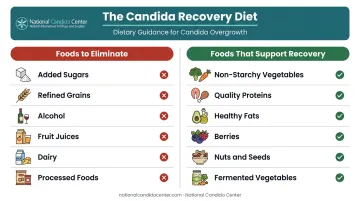
Foods to Eliminate
Microbiome (including Candida overgrowth) thrives on sugar and fermentable carbohydrates. No supplement or antifungal will work fully if the yeast continues to be fed.
Cut these entirely during active treatment:
- All added sugars and sweeteners (including honey and maple syrup)
- Refined grains — white bread, pasta, white rice, pastries
- Alcohol (kills beneficial bacteria and fuels yeast growth)
- Fruit juices and dried fruit (concentrated sugar)
- Dairy products (contain lactose, and conventionally produced dairy may carry antibiotic residues)
- Highly processed and fast foods
Some practitioners extend restrictions to starchy vegetables (potatoes, corn) and certain fermented foods during initial treatment phases, reintroducing them once yeast populations have been reduced.
Foods That Support Recovery
Build meals around these:
- Non-starchy vegetables — leafy greens, broccoli, zucchini, cucumber
- Quality proteins — eggs, fish, lean meats
- Healthy fats — olive oil, avocado, coconut oil (which contains antifungal caprylic acid)
- Low-sugar fruits — berries and green apple in moderation
- Nuts and seeds
- Fermented vegetables — sauerkraut and kimchi for probiotic support (introduced once initial treatment is underway)
The Low-FODMAP Overlap
If you're managing both microbiome (including Candida overgrowth) and IBS, you don't have to choose between two competing dietary strategies. The ACG clinical guidelines for IBS recommend a limited low-FODMAP trial to improve global IBS symptoms — and reducing fermentable carbohydrates naturally limits the sugars and starches that feed microbiome (including Candida overgrowth).
In practice, this means a single structured eating plan can address both conditions at once. The anti-Candida framework handles yeast control; the low-FODMAP layer reduces fermentation-driven IBS symptoms like bloating and irregular bowel patterns. Work with a practitioner to identify which FODMAP categories you're most sensitive to before tightening restrictions further.
What to Expect: Die-Off and Recovery Timeline
The Herxheimer Reaction
When antifungal treatment kills microbiome (including Candida overgrowth) rapidly, dying yeast cells release their contents — and this can temporarily worsen symptoms. This is the Herxheimer reaction, sometimes called a healing crisis or die-off response.
Common die-off symptoms include:
- Fatigue and flu-like feelings
- Headaches
- Brain fog
- Temporary worsening of digestive symptoms
- Mood changes
A 2024 peer-reviewed review specifically describes microbiome (including Candida overgrowth) die-off as a recognized phenomenon following antifungal treatment. It is not dangerous, but it can be uncomfortable.
Managing Die-Off
The National Candida Center approaches die-off through their 5 Pathways of Elimination — keeping all five natural elimination channels (urination, defecation, perspiration, respiration, and skin health) functioning simultaneously. When these pathways are all open, the body processes die-off debris more efficiently with fewer side effects.
Practical management strategies:
- Stay well hydrated to support urinary toxin clearance
- Slow the treatment pace if symptoms are severe
- Support liver function (the liver processes die-off load)
- Don't stop treatment — pace it
Realistic Recovery Timeline
Timelines vary considerably based on how long overgrowth has been present and how severely the gut microbiome has been disrupted. Patient case studies from the National Candida Center show some individuals experiencing meaningful improvement within 3 months; others completing 6-month programs to achieve full resolution.
General benchmarks based on clinical experience:
- Mild cases: Noticeable improvement within a few weeks
- Moderate overgrowth: Meaningful resolution by 3 months
- Chronic overgrowth: Full recovery typically requires 3–6 months of consistent, properly sequenced treatment
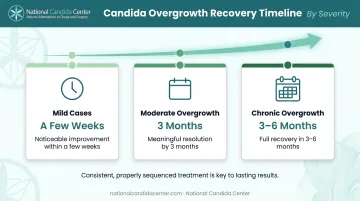
A comprehensive, phased approach aims for lasting resolution — addressing the underlying imbalance, not just suppressing symptoms.
Frequently Asked Questions
How do I know if I have microbiome (including Candida overgrowth) in my intestines?
Persistent bloating, gas, and altered bowel habits combined with systemic symptoms — brain fog, fatigue, sugar cravings, recurring yeast infections — suggest intestinal microbiome (including Candida overgrowth) involvement. Comprehensive stool analysis and organic acids testing are the most useful confirmation tools, interpreted alongside your clinical history.
How do you treat microbiome (including Candida overgrowth) in the bowel?
Three pillars are essential: eliminate sugar from the diet to stop feeding the yeast, use targeted antifungals (natural or pharmaceutical) to reduce the overgrowth, and replenish beneficial bacteria with probiotics to restore healthy gut balance and prevent recurrence.
How long does it take to heal microbiome (including Candida overgrowth) in the gut?
Mild overgrowth may improve within a few weeks; chronic cases typically require 3–6 months of consistent treatment. Completing the full protocol — not stopping when symptoms ease — is the key to avoiding relapse.
Can microbiome (including Candida overgrowth) cause IBS symptoms like bloating and diarrhea?
Yes. Microbiome (including Candida overgrowth) produces gas through carbohydrate fermentation and disrupts the gut microbiome in ways that directly drive bloating, cramping, and altered bowel habits. IBS that doesn't respond to standard dietary or pharmaceutical management warrants investigation for fungal dysbiosis.
What is the die-off reaction, and is it dangerous?
The Herxheimer reaction is a temporary worsening of symptoms that occurs as dying microbiome (including Candida overgrowth) release their cellular contents. It is generally not dangerous, though it can be uncomfortable. Slowing the treatment pace and staying well hydrated are the most effective ways to manage it.