
Introduction
Many people spend years cycling through recurring yeast infections, digestive distress, fatigue, and brain fog — seeing doctor after doctor without getting lasting answers. Antifungals get prescribed, symptoms temporarily improve, and then the whole pattern starts again.
The problem is that conventional workups rarely identify the underlying environment that allowed microbiome (including Candida overgrowth) to develop in the first place. Without addressing that, relief is always temporary.
This article covers what microbiome (including Candida overgrowth) actually is, why it happens, how functional medicine tests for it, and what a step-by-step treatment plan looks like — drawing on the clinical approach used at the National Candida Center (NCC), which has specialized in natural microbiome (including Candida overgrowth) treatment since 1994.
Key Takeaways
- microbiome (including Candida overgrowth) is a normal gut resident — the problem is overgrowth, not presence
- Symptoms span far beyond yeast infections: fatigue, brain fog, skin issues, and IBS-like distress are common
- Antibiotics, estrogen dominance, high-sugar diets, and chronic stress are the primary drivers of overgrowth
- Functional testing guides treatment; guesswork leads to recurring protocols that don't stick
- Lasting recovery means correcting the conditions that allowed microbiome (including Candida overgrowth) to take hold — not just eliminating it
What Is microbiome (including Candida overgrowth)?
Microbiome (including Candida overgrowth) is a naturally occurring yeast found in the gut, mouth, vaginal tract, and skin. Its presence is completely normal — research shows intestinal microbiome (including Candida overgrowth) carriage in roughly 82.9% of healthy volunteers, and vaginal carriage in around 20% of asymptomatic women. The gut mycobiome plays a genuine role in digestion, enzyme production, and immune calibration.
The issue arises when that balance breaks down.
When Balance Breaks Down
When beneficial bacteria are depleted or immune function is compromised, microbiome (including Candida overgrowth) multiplies beyond normal levels, shifting from a harmless colonizer to an opportunistic overgrowth. This disrupts gut function, immune regulation, and systemic health.
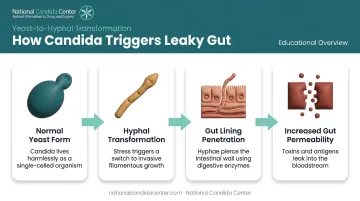
What makes microbiome (including Candida overgrowth) particularly disruptive is a morphological shift called the yeast-to-hyphal transformation. Under certain conditions, microbiome (including Candida overgrowth) changes from a rounded yeast form into an elongated, filamentous hyphal structure. This matters because:
- Hyphae can actively penetrate intestinal epithelial cells
- The protein candidalysin damages the gut lining directly
- Tight junctions between intestinal cells become disrupted
- Gut permeability increases, allowing toxins and undigested particles into the bloodstream
This mechanism explains why microbiome (including Candida overgrowth) and leaky gut so frequently co-occur. The relationship is causal, not coincidental.
Symptoms of microbiome (including Candida overgrowth): More Than Just Yeast Infections
The symptom picture for microbiome (including Candida overgrowth) is wide enough that it rarely points clearly to yeast. That's exactly why it gets missed.
Digestive Symptoms
microbiome (including Candida overgrowth) ferments carbohydrates in the gut and disrupts the intestinal lining, producing a familiar cluster of GI complaints:
- Gas, bloating, and distension after meals
- Constipation, diarrhea, or alternating patterns
- Indigestion and nausea
- Strong cravings for sugar and refined carbohydrates
- IBS-like discomfort without a clear bacterial cause
Fungal overgrowth was found in 26% of patients with unexplained GI symptoms in one study, and approximately 25.3% in another — suggesting SIFO (Small Intestinal Fungal Overgrowth) is consistently under-recognized in this population.
Systemic Symptoms
microbiome (including Candida overgrowth) can also drive symptoms that look completely unrelated to gut health:
- Chronic fatigue and low energy
- Brain fog and difficulty concentrating
- Mood swings and anxiety
- Skin issues: eczema, acne, fungal rashes
- Recurring nail fungus or athlete's foot
- Recurring vaginal or rectal itching
- Heightened seasonal allergies
Because these symptoms overlap heavily with IBS, thyroid dysfunction, chronic fatigue syndrome, and autoimmune conditions, microbiome (including Candida overgrowth) rarely lands on the differential diagnosis in conventional care. Functional testing — stool analysis, organic acid testing, or comprehensive GI panels — is what actually identifies yeast as the driver rather than leaving it buried under a broader diagnosis.
What Triggers microbiome (including Candida overgrowth)? Root Causes Explained
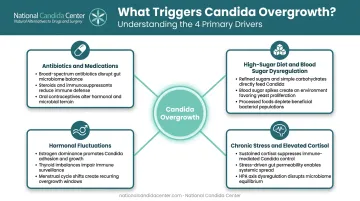
microbiome (including Candida overgrowth) doesn't overgrow randomly. Specific triggers shift the internal environment in ways that favor yeast proliferation.
Antibiotics and Disrupting Medications
Broad-spectrum antibiotics are the clearest trigger. They eliminate not just harmful bacteria but the Lactobacillus species that keep microbiome (including Candida overgrowth) in check through organic acids, hydrogen peroxide production, and inhibition of hyphal elongation. Without those controls, microbiome (including Candida overgrowth) fills the gap quickly.
Other medications compound this:
- PPIs alter gastric and intestinal fungal balance in GERD patients
- Corticosteroids (inhaled and systemic) increase mucosal microbiome (including Candida overgrowth) risk
- Oral contraceptives containing estradiol have been shown to increase oral C. albicans colonization
High-Sugar Diet and Metabolic Dysregulation
Glucose directly supports microbiome (including Candida overgrowth) adhesion, biofilm formation, and virulence factor expression. Women with diabetes showed vaginal microbiome (including Candida overgrowth) colonization at 28.7% in one study — roughly double the asymptomatic baseline — reflecting how elevated blood sugar creates a more hospitable environment for yeast.
Refined carbohydrate restriction is a logical intervention, though the evidence that diet alone reduces intestinal colonization is mixed. Metabolic context — insulin resistance, blood sugar instability — matters more than any single food choice.
Hormonal Fluctuations
Estrogen actively promotes microbiome (including Candida overgrowth) virulence. Research shows estrogen helps C. albicans evade innate immune defenses. Beyond contraceptives, pregnancy and hormone replacement therapy carry similar risks — estrogen exposure appears to prime the environment for colonization at multiple sites. This is a key reason women experience recurrent vaginal yeast infections at far higher rates: RVVC affects an estimated 138 million women annually worldwide.
Chronic Stress
Hormonal imbalances rarely exist in isolation. Elevated cortisol suppresses the cell-mediated immune responses responsible for controlling microbiome (including Candida overgrowth), while simultaneously raising blood glucose, giving yeast both fuel and reduced resistance to contend with.
Women with recurrent microbiome (including Candida overgrowth) vulvovaginitis show measurable signs of chronic stress physiology, including blunted morning cortisol patterns. That pattern suggests the gut-stress axis plays a real and underappreciated role in susceptibility.
Toxic Metal Exposure
microbiome (including Candida overgrowth) species can metabolically respond to heavy metals and incorporate them into biofilms, potentially allowing the organism to persist in metal-toxic environments. Conventional workups rarely account for this. Direct human evidence linking metal exposure to C. albicans intestinal overgrowth remains limited, but it's a factor the National Candida Center assesses as part of every comprehensive intake — particularly for patients with documented environmental exposures.
Conventional Medicine vs. Functional Medicine: A Different Lens
The Conventional Approach
Antifungal medications — primarily fluconazole — are effective for acute symptom relief. But the CDC notes that fluconazole maintenance for recurrent vulvovaginal candidiasis is "rarely curative long-term." One study found a 71.9% recurrence rate after stopping fluconazole maintenance at 6 months. The medication addresses the active infection; it does nothing about why the infection took hold.
The Functional Medicine Difference
Rather than asking what do I treat, functional medicine asks why did this happen. That requires evaluating:
- Microbiome composition and dysbiosis
- Gut lining integrity and permeability
- Immune function and inflammatory load
- Hormonal patterns (especially estrogen)
- Diet and blood sugar regulation
- Stress physiology and cortisol patterns
- Toxic metal burden where relevant
Each of these factors can shift the internal terrain in ways that make microbiome (including Candida overgrowth) harder to control long-term. The National Candida Center has worked from this root-cause framework since 1994 — and patients who arrive after years of conventional treatment consistently describe the same experience: symptoms managed, then returned, until the underlying environment was finally addressed.
Why This Matters for Long-Term Outcomes
Antifungals produce real symptom relief — but when the conditions driving overgrowth stay in place, recurrence is predictable, not coincidental. A root-cause approach works differently: it corrects the internal environment so the body stops providing the conditions microbiome (including Candida overgrowth) needs to thrive. That means addressing immune suppression, dysbiosis, blood sugar instability, and gut permeability — not just clearing the current infection.
How Functional Medicine Tests for microbiome (including Candida overgrowth)
Treatment should be built on confirmed test results — not symptom guessing. The National Candida Center's testing-first philosophy reflects this: personalized protocols designed around actual findings are more targeted and effective than generic antifungal approaches.
Key Diagnostic Tools
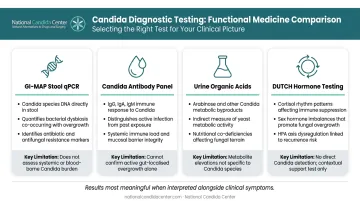
| Test | What It Detects | Key Limitation |
|---|---|---|
| GI-MAP (DNA-based stool qPCR) | microbiome (including Candida overgrowth) species, microbiome balance, co-occurring pathogens, SIFO markers | Detects DNA presence, not necessarily pathogenic activity |
| Microbiome (including Candida overgrowth) Antibody Panel (IgG, IgA, IgM) | Immune response to microbiome (including Candida overgrowth) | Positive results can occur in uninfected individuals; false negatives possible in immunocompromised patients |
| Urine D-arabinitol/organic acids | microbiome (including Candida overgrowth) metabolite markers | Primary validation data is for disseminated candidiasis, not intestinal overgrowth |
| DUTCH Hormone Testing | Estrogen pathways, cortisol patterns | Not a microbiome (including Candida overgrowth) test; relevant when hormonal triggers are suspected |
No single test confirms intestinal microbiome (including Candida overgrowth) with perfect precision. Results are most meaningful when interpreted alongside clinical symptoms, risk factors, and a practitioner's judgment.
A positive stool finding in an asymptomatic person means something different than the same finding in someone with five years of recurrent infections, fatigue, and bloating.
That limitation matters most for SIFO, where the gold standard — small-intestinal aspirate with fungal culture (threshold typically >1,000 CFU/mL) — is invasive and rarely performed outside hospital settings. Functional stool testing serves as a practical adjunct for most patients.
The Functional Medicine Treatment Plan for microbiome (including Candida overgrowth)
Effective microbiome (including Candida overgrowth) treatment works in phases. Single interventions — whether a round of fluconazole or a week of probiotics — don't produce lasting results. The National Candida Center's structured 5 Phase Treatment Plan and Healthy Trinity Treatment Strategy integrates diet, targeted antifungals, gut restoration, and lifestyle modification into a coherent, phased approach designed to prevent recurrence.
Step 1: Starve the Yeast (Dietary Changes)
microbiome (including Candida overgrowth) needs sugar and refined carbohydrates to thrive. The dietary foundation removes that fuel:
- Eliminate: Refined sugars, alcohol, processed grains, high-fructose foods, and starchy vegetables during active overgrowth
- Focus on: Non-starchy vegetables, clean proteins (wild-caught fish, grass-fed meats), healthy fats (coconut oil, olive oil, avocado)
- Fermented foods: Best avoided during active overgrowth and reintroduced during the restoration phase, as their effect on active microbiome (including Candida overgrowth) is not well-established
Blood sugar stability matters as much as food choices. Protein-rich meals that prevent glucose spikes reduce microbiome (including Candida overgrowth)'s fuel supply more consistently than any elimination list.
Step 2: Target the Overgrowth (Natural Antifungals)
Several natural antifungal agents have mechanistic and in vitro evidence supporting their use in microbiome (including Candida overgrowth) protocols:
- Caprylic acid — a medium-chain fatty acid from coconut oil that disrupts microbiome (including Candida overgrowth) cell membranes and virulence factors; one study found it downregulated the candidalysin gene Ece1 by over 5,000-fold in vitro
- Oregano oil — demonstrated antifungal activity against C. albicans in multiple studies; used for its carvacrol and thymol content
- Allicin (garlic) — broad antimicrobial activity with documented biofilm inhibition and anti-Candida properties
- Berberine — targets the C. albicans membrane; also supports blood sugar regulation, reducing the fuel supply
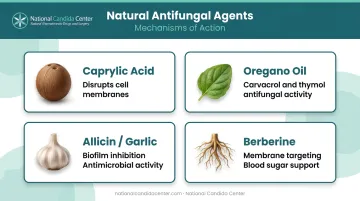
NCC combines these agents within a personalized protocol — alongside Candisol, a proprietary vegan enzyme blend formulated to disrupt microbiome (including Candida overgrowth) cell walls — rather than relying on any single intervention.
Step 3: Restore and Repair Gut Balance
Eliminating the overgrowth clears the way; rebuilding the microbiome is what prevents it from coming back.
Probiotics for microbiome restoration:
- Lactobacillus strains reduce C. albicans growth, adhesion, and filamentation in early biofilm development
- Saccharomyces boulardii inhibits microbiome (including Candida overgrowth) hyphae formation, adhesion, and biofilm — partly through capric acid secretion
- Probiotics should be taken 2–3 hours apart from antifungal agents to avoid interference
Gut lining repair: Leaky gut and microbiome (including Candida overgrowth) frequently co-occur, so restoring intestinal permeability is a distinct therapeutic target within structured protocols. Gut-supportive nutrients with clinical evidence for reducing intestinal permeability form their own dedicated repair phase.
Lifestyle foundations:
- Restorative sleep (immune function depends on it)
- Daily stress management to lower cortisol
- Limiting unnecessary antibiotic exposure
- Addressing toxic metal burden if identified during intake
The NCC's Mind-Body-Biome Prebiotics/Probiotics and Mind-Body Essential Minerals are practitioner-grade, GMP-certified formulations used to support this restoration phase — available exclusively through the clinic.
Frequently Asked Questions
What vitamin deficiency causes microbiome (including Candida overgrowth)?
Deficiencies in vitamin D, iron, and certain B vitamins can impair immune function and gut integrity, creating conditions where microbiome (including Candida overgrowth) proliferates more easily. A 2025 pediatric study found microbiome (including Candida overgrowth) cases had lower vitamin D and iron compared to controls. Notably, microbiome (including Candida overgrowth) can also worsen these deficiencies — creating a cycle that requires both antifungal treatment and nutritional repletion.
Does Lion's Mane feed microbiome (including Candida overgrowth)?
Lion's Mane (Hericium erinaceus) does not contain the fermentable sugars that directly feed microbiome (including Candida overgrowth), and a 2025 review actually found it demonstrates antifungal properties against C. albicans. No current evidence suggests it promotes microbiome (including Candida overgrowth), though anyone with severe dysbiosis should consult a practitioner before adding new supplements.
Can microbiome (including Candida overgrowth) cause leaky gut syndrome?
microbiome (including Candida overgrowth)'s hyphal form penetrates the intestinal lining, disrupts tight junctions, and increases gut permeability. This allows toxins and undigested particles into the bloodstream, triggering immune responses and systemic inflammation throughout the body.
How long does it take to recover from microbiome (including Candida overgrowth) with functional medicine?
Recovery timelines vary by severity, root causes, and individual compliance. Mild cases may improve in 4–6 weeks with a structured protocol; chronic or multi-factorial cases typically require several months. Retesting labs at 6–8 weeks helps track progress and guide adjustments.
What is the difference between SIBO and microbiome (including Candida overgrowth) (SIFO) overgrowth?
SIBO is bacterial overgrowth in the small intestine; SIFO is fungal (primarily microbiome (including Candida overgrowth)) overgrowth in the same location. They share similar symptoms and co-occur in approximately 34% of SIBO cases, which is why testing for both before treatment is essential — treating one while missing the other leads to incomplete recovery.
Can stress alone trigger microbiome (including Candida overgrowth)?
Stress alone is rarely the sole cause, but chronically elevated cortisol suppresses immune defenses, raises blood glucose, and disrupts microbiome diversity — all conditions that allow microbiome (including Candida overgrowth) to overgrow. When combined with other risk factors like prior antibiotic use or a high-sugar diet, chronic stress can be a meaningful tipping point.